Summary
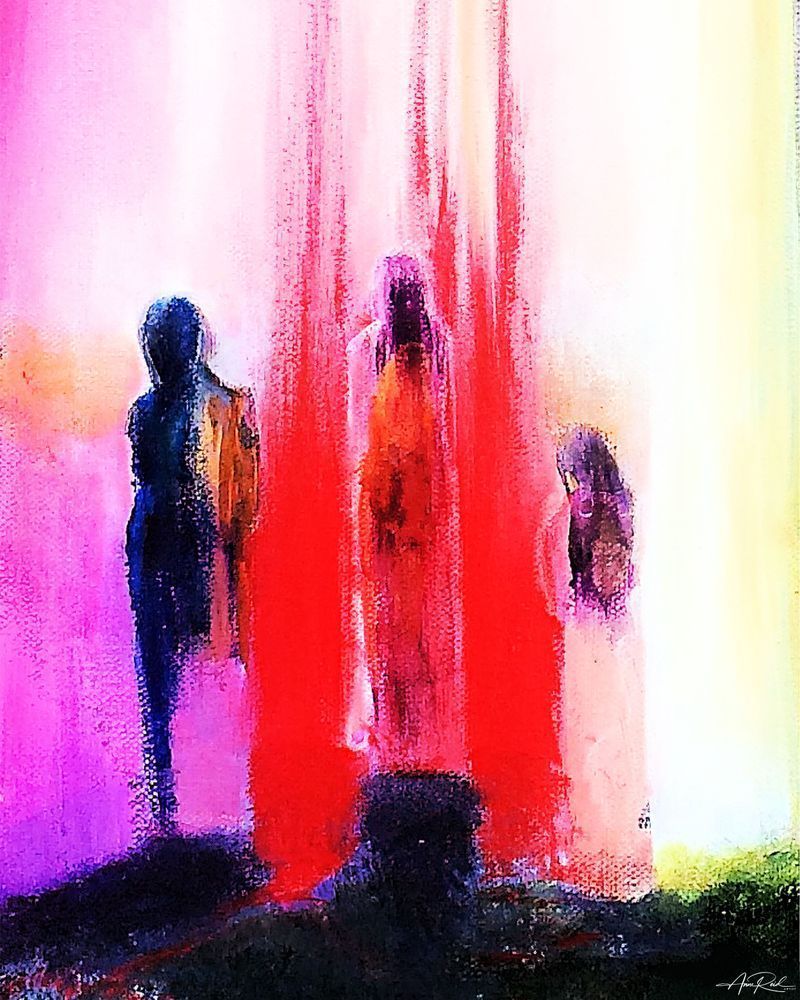
Golgotha 3, print is an open-edition detail-crop fine art print drawn from the original 2017 acrylic painting Golgotha by Anne Reid Artist. Three figures stand inside a descending column of crimson, rose, and white light — the women who remained at the foot of the cross when others fled. The red is the blood of Christ. The red and white together are the torn veil. The purple and crimson carry the colors of the priestly garments and the tabernacle. This is the moment of access: the Holy of Holies opened, the way through made available to all.
Artwork Statement
When I look at Golgotha 3, what I see is intimacy. The secret place. These figures are not standing outside looking in — they are entering into the Holy of Holies. Communion with God. Union with Christ. The veil is not a barrier anymore; it is a doorway, and they are moving through it.
The women who stayed at the foot of the cross stayed because they loved Him. Not out of duty or theological conviction — out of deep personal connection. While most of the disciples fled, these women remained. They were there because of who He was to them. And because they were there, they became the first witnesses to everything that followed.
Jesus had a special heart for women. He freed them. The Samaritan woman at the well became the first evangelist. He destroyed not only the wall of hostility between humanity and God, but the wall between men and women. The veil torn from top to bottom opened the Holy of Holies to everyone — not just to the High Priest once a year on the Day of Atonement, but to all who come through the blood of Christ.
Under the Old Covenant, the temple itself enforced that separation architecturally. Women could enter the Women's Court — the outermost court — and no further. The Court of Israel, the Court of Priests, the Holy Place, and the Holy of Holies were all closed to them. In this painting, these women are not in the outer court. They are inside the veil. That is what the Cross changed.
And it was a woman who first saw the resurrected Lord. Mary Magdalene stayed at the tomb when even Peter and John had gone. Jesus spoke her name, and she became the first witness to the resurrection — sent to tell the others. The one who had been excluded from the inner courts was the first to carry the news of the new creation.
I always saw the red in this painting as the blood of Jesus and the red and white together as the torn veil. Looking at it now, I can also see the purple and crimson as the colors of the priestly garments — the tabernacle woven into the scene of the Cross. The cross was the final temple. What happened at Golgotha fulfilled everything the temple rituals had been pointing toward.
These women are inside that. They are not in the outer courts. They are in the presence of God, moving through the opened place, enveloped in the light that the blood of Christ made available. That is what this painting is about: access, intimacy, and the freedom that Jesus purchased — freedom that women in particular are still stepping into. In my lifetime, in the last thirty years, I have watched women recognized as pastors, prophets, apostles, and evangelists in the church. That is a big leap forward. And it is rooted in this moment — three women at the foot of a cross, staying when others left, being the first to see.
"And behold, the curtain of the temple was torn in two, from top to bottom." (Matthew 27:51)
"He was pierced for our transgressions… and by his wounds we are healed." (Isaiah 53:5)
Variation & Edition Notes
Golgotha 3 is an artist-directed detail-crop edition drawn from the original 2017 acrylic on canvas painting Golgotha. The crop isolates the three central figures within the descending light column, removing the cross, the skulls, and the wider landscape. The aspect ratio shifts from the original 2:3 to a 4:5 vertical format. The crop concentrates the image on the threshold moment — not the place of death, but the opened way. Standard print preparation applied for color fidelity and print-ready clarity. No compositing, AI generation, or added elements.
To view the full composition including the cross and the wider scene, see Golgotha, print.
Color & Mood
- Red: the blood of Christ — the central vertical streams descending through the composition
- Red and white together: the torn veil — no longer a solid barrier but a fluid, luminous passage
- Purple and crimson: the colors of the priestly garments and the tabernacle — the Old Covenant woven into the scene of the Cross
- Left field: deep magenta and hot pink — warm, saturated, the weight of what is being entered
- Right field: luminous white and pale yellow — the opening of light, the presence of God
- Ground: deep navy-black — the dark place the figures stand in before the light
- Mood: intimate, sacred, and quietly powerful — figures held inside the light rather than observing it from outside
- Spiritual tone: access, intimacy, the Holy of Holies opened, union with Christ
Design Notes
- Vertical 4:5 crop — tighter and more intimate than the original 2:3 full painting
- The removal of the cross and skulls shifts the focus from the place of death to the threshold of entry — the veil and the figures moving through it
- The composition reads left to right as a journey: the figure on the far left stands in deep blue-purple shadow; the central figure is immersed in crimson blood and the tearing veil; the figure on the right is bathed in soft white-gold light — shadow to sacrifice to radiant presence
- Three figures at human scale create an immediate relational quality — the viewer is drawn in alongside them
- The vivid magenta and crimson palette suits contemporary interiors with white, cream, or warm neutral walls
- The crimson vertical streams read boldly from a distance; the figure detail and color symbolism resolve on closer view
Where It Works
- Living room or primary suite as a vivid, meaning-laden focal point
- Prayer room, chapel, or counseling office where the meaning of access, intimacy, and entry anchors the space
- Entryway or hallway where a vertical figure piece creates presence at the threshold of a home
- Ministry space, church office, or retreat centre
- Contemporary interior with white or cream walls where the magenta and crimson palette can speak fully
- Women's ministry space, retreat setting, or any context where the freedom Christ purchased for women is a living theme
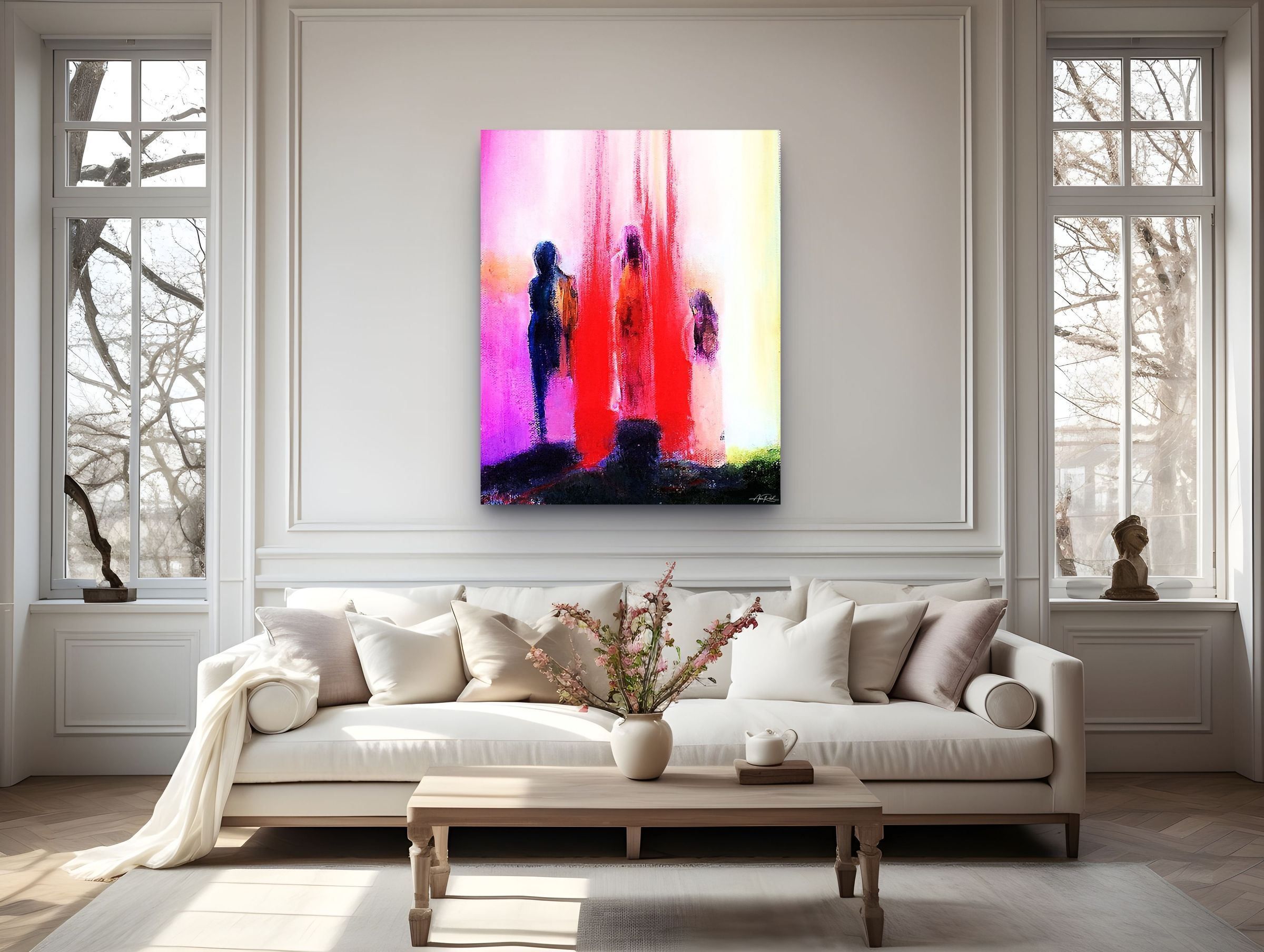
Golgotha 3, fine art print — shown as a 40×50 in canvas print in a living room setting.
Print Options & Materials
- Open-edition detail-crop fine art print drawn from the original 2017 acrylic on canvas painting
- Available on paper, metal, canvas, and acrylic — select your preferred medium from the Options menu above
- Metal and acrylic are especially strong for this edition — the vivid crimson, magenta, and white palette reads with exceptional luminosity on reflective surfaces
- 48×60 in is available on metal only
- Canvas offers a painterly warmth that suits the figure-and-light atmosphere of this work
Bathroom Suitability
For humid bathrooms or spa rooms, choose metal or acrylic. For dry powder rooms, framed paper works beautifully. Canvas is best reserved for dry, well-ventilated spaces.
Select the dropdown option below to choose your size and medium, or visit my Sizing & Placement Advice page for help choosing.
Sizing Guidance
- Aspect ratio: 4:5 vertical
- Available sizes: 8×10, 9×11, 16×20, 24×30, 32×40, 40×50, and 48×60 in — select from the Options menu above
- 8×10 and 9×11 in: intimate devotional size for a bedside wall, prayer corner, or desk area
- 16×20 and 24×30 in: versatile mid-range sizes suited to living rooms, hallways, and home offices
- 32×40 in: a large-format statement size; the figures and light carry full relational presence at this scale
- 40×50 in: a commanding statement size for living rooms, sanctuaries, and significant walls
- 48×60 in (metal only): architectural-presence scale — immersive and fully room-commanding
- Placement tip: over a sofa, console, bed, or sideboard, aim for artwork width around 60–75% of the furniture width
- Hanging tip: center the artwork at approximately 57–60 in from the floor, or hang 6–10 in above furniture
Quality & Care
Each print is produced to order using professional fine-art materials selected for color fidelity, clarity, and long-term presentation. Handle with clean, dry hands, avoid prolonged direct sunlight, and follow the care guidance appropriate to your selected medium.
Shipping & Fulfillment
Orders are produced to order and shipped by my professional print lab partner in the United States. Production and transit times vary by size and finish; tracking is provided when your artwork ships. International orders may be subject to local duties, taxes, or import fees at delivery.
Integrity Notes
Golgotha 3, print is an artist-directed detail-crop edition drawn from my original human-made acrylic on canvas painting Golgotha (2017). The crop isolates the three central figures within the descending light column and shifts the format to a 4:5 vertical. Standard print preparation applied for color fidelity and print-ready clarity. No compositing, AI generation, or added elements.
Copyright & Credits
© 2017, 2026 Anne Reid Artist. All rights reserved. Original painting: Golgotha, 2017, acrylic on canvas, 24×36 in; studio original, available.
Notes from the Studio
I began with color and movement, the way I begin most paintings. The figures in the light emerged from the larger Golgotha canvas — and when I isolated them in this crop, they carried something the full painting holds differently. Not the place of death. The threshold of entry. The figures are not watching from outside. They are inside the light. That is what I wanted this print to say.
Pairing Ideas
Further Reading
Need sizing or placement advice? Visit my Sizing & Placement Advice page or contact me: info@annereidartist.com