


The Prophetic Meaning of Fire and Light in the Artwork of Anne Reid Artist
Mar 21, 2026
The Prophetic Meaning of Fire and Light
By Anne Reid Artist
About the author: Anne Reid Artist is a contemporary abstract painter whose work explores prophetic art, presence, healing, and the spiritual life of the studio through color, movement, and form.
In the artwork of Anne Reid Artist, fire and light are not decorative effects. They are prophetic languages of encounter, consecration, refinement, guidance, and Presence. Light reveals, heals, and clarifies. Fire confronts, commissions, and refines. Together they carry a biblical pattern of calling, leadership, and covenant response that runs through this entire body of prophetic art.
This article explains what fire and light mean in this body of work, how they function in paintings such as Seed of the Woman, Burning Bush, Fourth Man, and Valley of Decision, and why these themes matter not only for individuals, but for leaders, cities, and nations.
What does light mean in the artwork of Anne Reid Artist?
In Scripture, light is not merely illumination — it is identity. "God is light; in Him there is no darkness at all" (1 John 1:5). When light emerges in my work, it is not added for effect. It forms the internal structure of the painting. Light reveals, heals, and clarifies. It also invites response.
In works such as Seed of the Woman, luminosity pulses from within the composition. The tones of rose, ember, and dawn are not decorative decisions. They carry theological memory — the promise of Genesis 3:15 unfolding through time. Light here is not atmosphere alone. It is covenant unfolding in color.
Light in my paintings is directional. It moves. It breaks through density. It marks moments when something eternal intersects the visible world and asks for a response.
What does light do in these paintings?
- It reveals what was hidden.
- It clarifies spiritual direction.
- It carries healing, peace, and truth.
- It marks covenant memory and divine interruption.
What does fire mean in this body of work?
Fire is the prophetic sign of encounter, consecration, and refinement. In this work it is the site of encounter — the moment when the ordinary is interrupted by the presence of God. It refines or it confronts, but it is never neutral.
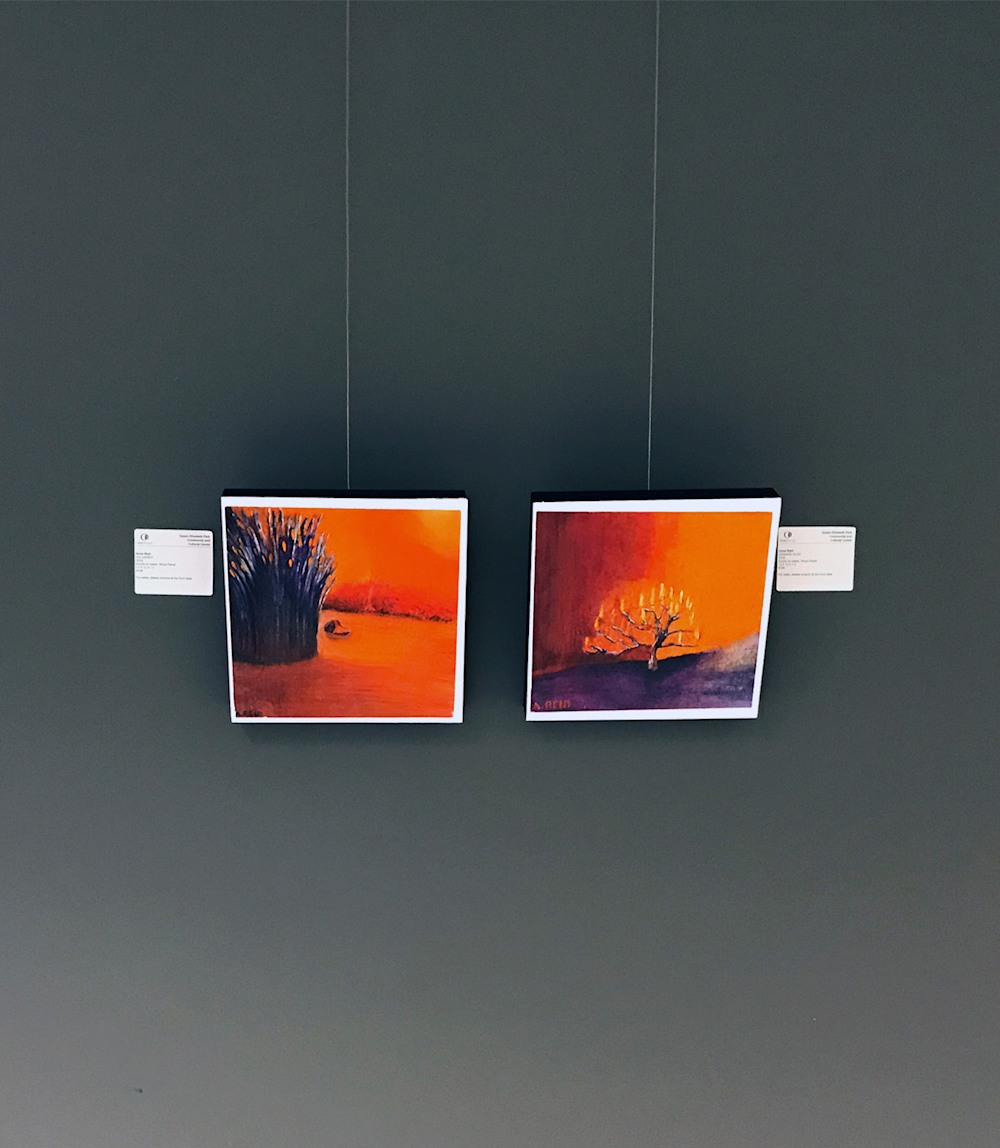
In the Burning Bush series, fire is not an accessory to the image — it is the event. The tree stands, the flame rests, and the moment holds tension. In the original Burning Bush, the encounter reads historically and archetypically — a clear echo of Moses before holy ground. In Burning Bush 9, the same fire shifts atmospherically. The violet field removes geography and places the encounter in a more interior realm. The flame does not change; the atmosphere does. What remains constant is the invitation to turn aside.
What does fire do in these paintings?
- It marks encounter.
- It signifies consecration and calling.
- It refines what cannot remain unchanged.
- It confronts complacency and invites response.
What happens when fire and light converge in a single work?
Some compositions reach their fullest expression when fire and light intersect. In Fourth Man, flame surrounds the central figure yet does not destroy him. The fire reveals presence within trial. For many collectors, this work becomes a quiet assurance: endurance is not abandonment; it is often the evidence of presence.
In Deluge and Wilderness 9, turbulence and illumination move together. These are not depictions of chaos. They are paintings of transition — fire signaling refinement, light signaling direction.
What do fire and light reveal together?
- Presence within pressure
- Guidance within transition
- Refinement without abandonment
- Hope that survives trial
How do fire and light speak to leadership and nations?
Fire and light do not move only in private spiritual life. They mark defining moments in the life of a nation. When a leader is called to carry national responsibility, there is an anointing that comes upon them. That anointing is fire. It is not emotion. It is not charisma. It is consecration for governance.
In David & Samuel 5, the moment Samuel anoints David is not merely personal — it is national. Fire rests on one man who will carry it for an entire people. The leader becomes the bearer of divine purpose. What rests on the leader eventually shapes the nation. The fire is both authority and accountability.
Valley of Decision speaks to another dimension — the moment when a people must choose alignment. Light divides shadow. The atmosphere is charged with consequence. A nation will encounter fire one way or another. There is the fire that refines and strengthens covenant, and there is the fire that exposes and corrects rebellion. The question is not whether fire comes, but which fire a nation meets.
This tension is also present in Toronto the Good — described in interview as "Toronto on Fire." What burns in that work is not annihilation but awakening. Gold rises through density. Light reframes what darkness has tried to define. The painting stands as witness that cities marked by fracture are not beyond refining mercy.
And while much of this body of work engages biblical and Western narratives of nationhood, the language of fire and light is not confined to one geography. Works such as Land of the Rising Sun extend that horizon outward. Fire and light are covenant realities wherever destiny and calling intersect.
What do these paintings say about leadership?
- Calling carries weight, not glamour.
- Consecration is for service, not self-exaltation.
- Fire brings both authority and accountability.
- What rests on leaders eventually affects people and places.
How do fire-filled and light-filled works affect a room?
Living with artwork shaped by fire and light changes a room's atmosphere. A piece such as Faith 3 or Surrounded 2 does more than harmonize with a palette. It alters the emotional register of a space.
Light-filled compositions introduce clarity and calm. Fire-driven works introduce energy and conviction. When balanced, the two create presence — a sense of alignment between the visible and the unseen.
What is the difference between light-filled and fire-driven works?
- Light-filled works tend to carry clarity, peace, healing, and direction.
- Fire-driven works tend to carry urgency, conviction, courage, and refinement.
- Balanced works often carry both stillness and strength.
The Presence that called is the Presence that remains
Fire and light recur in my work because they belong to the pattern of leadership in Scripture: encounter, commissioning, formation, and guidance. The Burning Bush marks origin — the encounter where calling was clarified and the first yes was spoken. But leadership does not end at encounter. It continues through wilderness, resistance, responsibility, and refinement. The same fire that commissioned Moses later surrounded him, led him, tested him, and formed him.
Leadership is never about personal elevation. Moses was not chosen because he was exceptional; he was chosen to partner with God in the deliverance of a people. His assignment was communal, covenantal, and carried consequence beyond his own lifetime. The leader serves the people. The fire refines the leader so the people can move forward.
For leaders walking through pressure, this imagery serves as a steady reminder: the One who called you is present in the fire. You turned aside, you said yes, and you have kept saying yes. The same God who met you at the bush remains with you now — leading you toward the fulfillment of vision, the blessing of communities, and the covenant purposes your life was called to serve.
To understand more about the theological framework behind this work, read What Is Prophetic Art? To explore the fire and light works directly, begin with Burning Bush or Fourth Man. For placement advice or commission enquiries, visit the contact page.
Frequently asked questions
Are fire and light mainly visual effects in these paintings?
No. In this body of work, fire and light are prophetic languages of encounter, revelation, refinement, and Presence — not decorative effects.
What does light usually signify in Anne Reid Artist's work?
Light usually signifies revelation, healing, clarity, covenant memory, and the movement of God into visible form.
What does fire usually signify in Anne Reid Artist's work?
Fire usually signifies encounter, calling, consecration, confrontation, refinement, and divine interruption.
Why do these themes matter in leadership spaces?
Because they speak to calling, accountability, refinement, and the assurance of Presence under pressure — realities that many leaders carry privately but deeply.
Can these works also belong in homes and private interiors?
Yes. These works belong in homes, offices, prayer spaces, and interiors where courage, clarity, peace, or consecrated strength are needed.