


Prophetic Art and the Human-Made Movement: Why This Category Can No Longer Be Ignored
Mar 11, 2026
What Is Prophetic Art — And Why It Is Not a Niche
By Anne Reid Artist
About the author: Anne Reid Artist is a contemporary abstract painter whose work explores prophetic art, presence, healing, and the spiritual life of the studio through color, movement, and form.
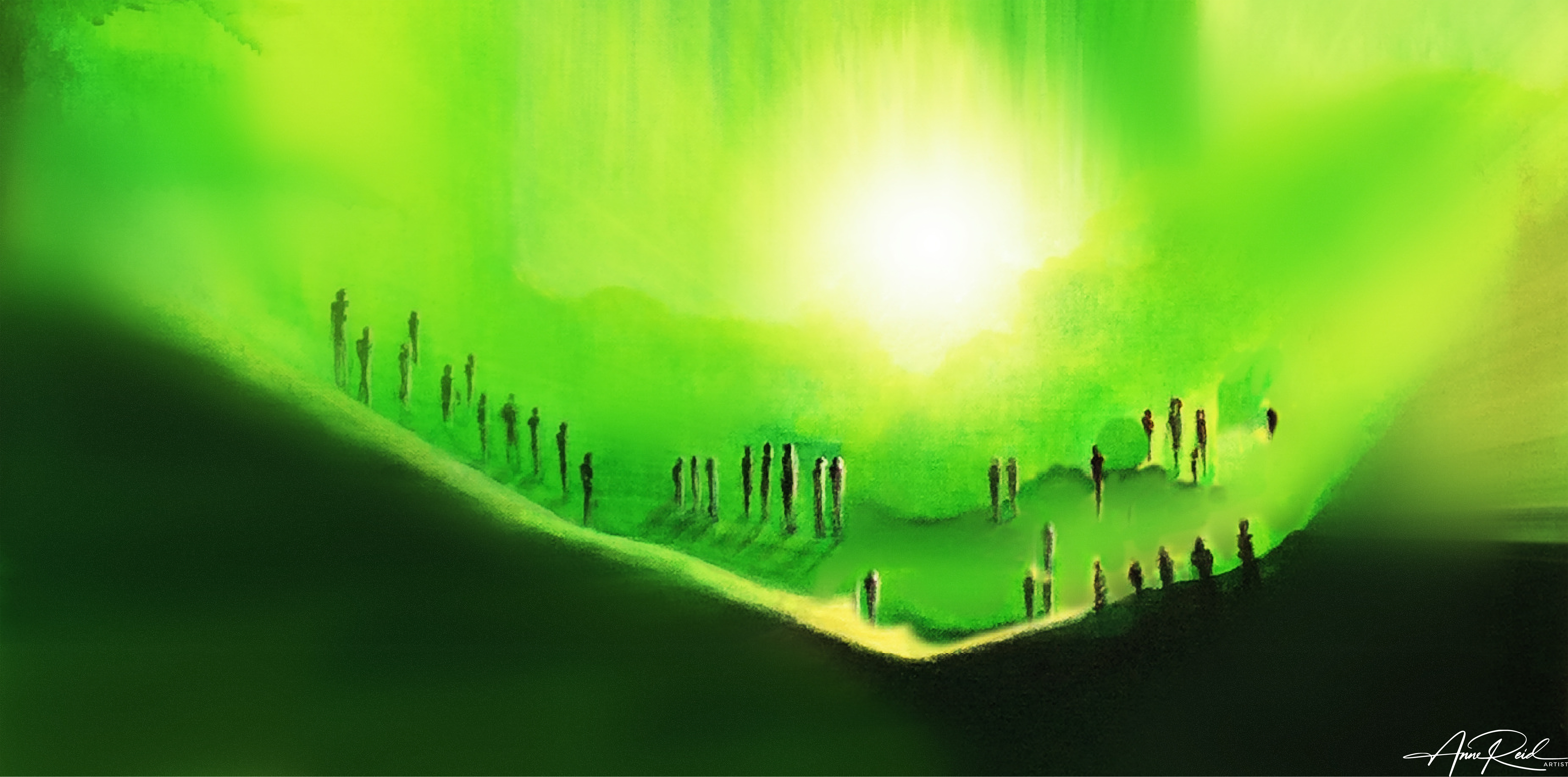
Prophetic art is not primarily a style, medium, or trend. It is a Christ-centered mode of artmaking and witness: work made in responsive communion with God, under the authority of Scripture, with the intention of bearing faithful witness to Jesus Christ through visual form. What makes it prophetic is not that it looks spiritual. What makes it prophetic is source.
This article explores what prophetic art actually is, why it has remained undernamed for so long, and why the conversation about human-made art becomes more meaningful when categories like this are seen clearly. For the foundational definition, see What Is Prophetic Art?
Why prophetic art is not a small or private Christian niche
There are real signs that serious Christ-centered work can move publicly, culturally, and at scale when the quality is high and the delivery system is strong.
The official The Chosen ecosystem reports the series has been streamed by over 240 million people across 50+ languages, supported by more than 100,000 backers in 150+ countries. Those are not church-basement numbers. They show that serious Christ-centered work can move at global scale when the quality is compelling and the form is right.
There is also growing evidence that spiritually serious Christian interest is rising, particularly among younger adults. Barna reported in 2026 that 45 percent of senior pastors were seeing higher Gen Z engagement, 42 percent said the same of Millennials, and 40 percent reported increased engagement among men ages 18 to 35 — findings Barna connects to rising spiritual curiosity, greater openness to Jesus, and increased Bible reading among younger generations.
That does not prove a settled cultural shift, and it should not be overstated. But it is enough to say that public openness to Christian meaning is not a dying category. It is moving. And the question worth asking is not whether there is an audience for human-made art in general, but whether there are meaning-rich movements inside that world that the current art system has consistently under-read. I believe prophetic art is one of them.
What prophetic art is — and how it differs from spiritual or Christian art
Prophetic art is art made in responsive communion with God, under the authority of Scripture, with the intention of bearing faithful witness to Jesus Christ through visual form. It may be figurative or abstract, quiet or bold, and may address peace, grief, mercy, justice, healing, repentance, longing, consolation, or hope. What defines it is not its visual style but its source: prayer, discernment, obedience, and witness.
That distinction matters because not all spiritual art is prophetic art, and not all Christian art is prophetic art.
- Spiritual art may draw on broad or eclectic spiritual themes without being explicitly centered in Christ.
- Christian art may be sincere and faithful in content without being prophetic in process or source.
- Prophetic art, as I mean it here, is Christ-centered work shaped by prayer, discernment, obedience, and witness — narrower and deeper than either of the above.
The biblical center of this is clear. Revelation says that "the testimony of Jesus is the spirit of prophecy," and Jesus says in John that He is "the way, and the truth, and the life." Those texts together give a remarkably precise lens: prophetic art bears witness to Christ by the way it is made, the truth it serves, and the life it carries. That is not a style argument. It is a theological one.
Why prophetic art has remained undernamed
Prophetic art has often lived between systems: too explicitly Christ-centered for much of the contemporary art world, and too visually ambitious or long-horizon for many church environments.
Most serious public discussion of contemporary art does not know what to do with overtly Christ-centered language unless it is translated into softer categories — spirituality, ritual, heritage, or identity. At the same time, much of the Christian world has not built robust public language for serious contemporary art. So prophetic art has fallen between the two.
Inside many church environments, "prophetic art" has often meant activation, creative freedom, healing, and encouragement. That is real and valuable — it has helped many artists begin. But beginning and maturing are not the same thing. Serious fine art requires time, repetition, visual intelligence, material control, and years of disciplined labor. The prophetic art movement has often given people permission to start. It has not always given them the structures necessary to become highly developed artists.
That is not an attack on the movement. It is a clarification of what still needs to be built.
The gap between formation and public visibility
One of the biggest problems facing serious prophetic artists is not a lack of sincerity. It is a lack of fit between formation, visibility, patronage, and public discoverability.
The church has often made symbolic room for artists, but not sustained patronage. It has made room for live painting, worship environments, and creativity as ministry. It has rarely funded long-horizon artistic development the way historic patronage systems once did.
The mainstream art system can recognize seriousness, but it still often requires overtly Christian work to pass through secular filters before it is treated as legible.
And the artist remains inside the oldest practical reality of all: skill takes hours, hours require time, and time requires provision.
This is why the distinction between mentoring ecosystems and platform ecosystems matters. Mentoring helps artists grow. Public infrastructure — discoverability, category placement, market-facing presence — is what makes a movement publicly legible rather than mainly talking to itself.
Why "human-made" is a beginning, not a finished category
Human authorship matters deeply. But human-made is an important beginning, not a complete category. Many kinds of work can all be human-made while carrying radically different levels of seriousness, depth, meaning, and witness.
Prophetic art sharpens the conversation by asking questions the AI-era debate often flattens:
- What is the source of a work?
- What kind of witness does it carry?
- What kind of truth is it serving?
- What kind of life, consolation, or clarity does it bring into a room?
- Is the work merely original, or is it meaningful?
- Is it human-made in a way that carries moral, spiritual, and symbolic depth?
Those questions matter more in a synthetic age, not less. The more visual production becomes abundant, the more people search for work that feels authored at the level of conscience, burden, sacrifice, and presence.
There is also hard market evidence that explicitly Christ-centered visual work can command serious attention. Vanessa Horabuena's site currently lists original works in the mid-five-figure range, and a widely reported live-painted portrait of Jesus by her sold for $2.75 million in early 2026. One case does not define a category, but it does challenge the assumption that there is no serious audience for overtly Christ-centered art.
What makes prophetic art worth serious attention
Prophetic art is worth serious attention not because it is automatically holier than other art, and not because every artist using the term is producing mature work. It matters because, at its best, it joins several things the current culture is desperate to reconnect:
- Human authorship
- Spiritual seriousness
- Symbolic meaning
- Disciplined craft
- Redemptive imagination
- Long-form witness
It is not décor with religious themes. It is not inspiration translated into color. At its strongest, prophetic art is visual work shaped by prayer, truth, and obedience — work with enough seriousness to enter public space without apologizing for its source.
Why this may be a threshold moment for prophetic fine art
For many Christian artists, there have long been places of encouragement and activation — mentoring, community, spiritual support. There have been far fewer places where artistic seriousness, public discoverability, market structure, and spiritually grounded meaning can stand together.
That may be beginning to change. The future of human-made art will not be secured by anti-AI rhetoric alone. It will come from the recognition, support, and surfacing of kinds of work whose value comes from more than authorship in the abstract — work that carries meaning, depth, witness, risk, formation, and cultural consequence.
Prophetic art is not a fringe devotional side note. It is an emerging category of human-made art whose fullest value lies in source, witness, meaning, and encounter. If you are new to this territory, begin with What Is Prophetic Art? or explore the full prophetic art collection. For conversations about placement, commission, or collecting, visit the contact page.
Frequently asked questions
Is prophetic art mainly a style category?
No. Prophetic art is not primarily a style category. It is a Christ-centered mode of artmaking and witness shaped by source, prayer, discernment, obedience, and faithful witness to Jesus Christ.
Is all Christian art prophetic art?
No. Some Christian art is sincere and faithful in content without being prophetic in process or source. As used here, prophetic art is narrower and deeper than Christian art in general.
Is spiritual art the same as prophetic art?
No. Spiritual art can be generalized, eclectic, or non-Christ-centered. Prophetic art, in the sense used here, is explicitly rooted in Christ, Scripture, prayer, and witness.
Is prophetic art only relevant inside church culture?
No. One of the central arguments here is that serious prophetic art has been under-read precisely because it has lived between systems. Its relevance is not confined to church settings — it belongs in homes, workplaces, hospitality spaces, and any environment where meaning and beauty matter.
Does every prophetic artist work the same way?
No. Artists may describe prophetic art differently. Some receive a clear image before they begin; others discover the work as it unfolds. What I describe here reflects my own lived experience of painting in relationship with God.