


Creating a Sacred Space at Home with Spiritual Art
Mar 14, 2026
Creating a Sacred Space at Home with Spiritual Art
By Anne Reid Artist
About the author: Anne Reid Artist is a contemporary abstract painter whose work explores prophetic art, healing, presence, and the role of spiritual atmosphere in the home through color, movement, and form.
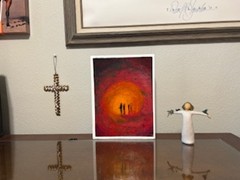
There is a particular quality of stillness in a room that has been set apart for prayer. You walk in and something in you slows down — not because the room is grand or perfectly decorated, but because you have returned to it faithfully, day after day, and it has become a place your spirit recognizes.
That is what a sacred space at home does. And it does not take much to create one.
This guide walks through what a prayer corner or home altar actually does, how spiritual art can serve that kind of space, and how to begin — simply and intentionally. For the theological foundation behind spiritually rooted artwork, read What Is Prophetic Art?
What is a sacred space at home?
A sacred space at home is not a décor category. It is a place set apart — a corner, a chair, a single anchored wall — where your attention can return to God. Where your heart can slow down, remember, and become still.
It does not need to be large or elaborate. A prayer chair by a window, a shelf with a Bible and a candle, or one wall anchored by a single meaningful artwork can all function as sacred space. What makes a space sacred is not complexity — it is consistency and intention.
What sacred space is — and is not
- It is a place of prayer, scripture, contemplation, and quiet return.
- It is a physical anchor for daily spiritual rhythm.
- It is not a performance of religious aesthetics.
- It is not dependent on size, expense, or visual complexity.
What does a prayer corner or home altar actually do?
A prayer corner gives physical form to spiritual rhythm. Over time, that matters more than most people expect.
When a space is kept simple, truthful, and uncluttered, it becomes easier to inhabit daily. Your body learns the place. Your spirit begins to recognize it as a place of peace, listening, and renewed attention. The return becomes quicker — not because you willed yourself there, but because the space itself has become a cue.
Why a well-ordered space helps you stay
- It makes prayer physically repeatable.
- It reduces distraction and visual noise.
- It helps the heart settle more quickly.
- It gives daily faithfulness a visible home.
Different rooms ask different things of us. A bedroom needs softness and restraint so the body can rest. A prayer space needs its own kind of order — one that helps you become still, listen, pray, journal, and shut out enough noise to be with God.
That does not mean a sacred space must be bare. Many people keep meaningful objects nearby — scriptures, journals, photographs, mementos that serve as altars of remembrance for what God has done and what they are still trusting Him for. The goal is not to fill every surface. It is to choose carefully, so the room helps you focus rather than scatter.
This matters especially in seasons of pressure, grief, transition, or sustained responsibility. A new mother, a busy leader, someone moving through loss or change — each may need one room where the door can close and the world can be shut out long enough to be strengthened again. A sacred space becomes an oasis.
Over time, the artwork in that space may need to change. A piece that served one season may give way to another when God brings new vision, new courage, or a new assignment into view. Reordering the room can become part of responding to what He is saying now.
How does spiritual art serve a sacred space?
Spiritual art is not an object of devotion. It is a visual anchor — something that helps steady the atmosphere of a room and return your attention to truth, hope, courage, peace, or the presence of God.
Works created prayerfully often carry something before they are fully explained. They may hold a sense of presence, stillness, fire, protection, healing, or light. For fuller language around that, begin with What Is Prophetic Art?
What spiritual art can do well in a sacred space
- Establish a calm, prayerful atmosphere.
- Give visual focus to a room or corner.
- Support remembrance, reflection, and daily return.
- Carry symbolic meaning that strengthens the room over time.
What spiritual art should not try to do
- It should not become visual clutter or compete with everything else in the room.
- It should not replace prayer, scripture, or real devotion.
- It should not be chosen only because it looks generically religious.
Choosing art by atmosphere and assignment
For those in ministry, leadership, or intercession, the room is not neutral. The eyes and the imagination receive cues constantly. A visual anchor in the right place does more than solve a design problem — it can help a person remain steady, remember what they are carrying, and keep their attention fixed on what they are called to.
This is one reason I create fine art prints for Christians who want to curate the atmosphere of significant spaces — in the home, in ministry, in business, and in places of leadership. The goal is not to decorate a wall. It is to give the eyes a place to land and the room a clear, meaningful focal point.
In a prayer space, for example, a work like Fourth Man can become a steady reminder of the presence of God in the fire, courage under pressure, and the call to keep going with faith. Ministry of Reconciliation may serve prayer over family, salvation, broken relationships, churches, or nations. Emergence can serve someone carrying a burden for the next generation or new voices coming forth. Seed of the Woman may speak to those praying about the Church, governmental authority, territory, and the authority of believers gathered in prayer. The Apple may be a meaningful focal point for intercession for Israel and covenant promises. Pentecost or Burning Bush may support prayer for revival, fire, and fresh outpouring. Proof may be a fitting anchor for those praying for physical healing and testimony.
How do you begin creating a sacred space at home?
Begin with one small, faithful decision — not a perfectly designed room.
- Choose one corner and make it consistent.
- Place one artwork there that carries the atmosphere you want the space to hold.
- Add one light source — a lamp or candle.
- Keep a Bible or journal nearby.
- Return to that space daily, even briefly.
Do not wait until you can make it beautiful in a grand way. Sacred space begins with intentionality, not scale. A simple corner you actually return to is far more powerful than an elaborate setup you rarely use.
Which artworks work well in a prayer corner or sacred space?
When choosing a piece for a prayer corner, study, or quiet room, begin by asking: What does this space need to hold? Choose by atmosphere and assignment — not only by color or style.
- Dove — for peace, rest, gentleness, and healing.
- Deluge — for cleansing, renewal, movement, and living flow.
- Fourth Man — for crisis, courage, pressure, and the presence of God in the fire.
- Ministry of Reconciliation — for salvation, family restoration, mercy, healed relationships, churches, and nations.
- Emergence — for youth, the next generation, new leaders, prophetic voices, and courage to rise.
- Seed of the Woman — for ecclesia, authority, territory, culture, and believers gathered in prayer.
- The Apple — for intercession for Israel, covenant remembrance, Jerusalem, and God's purposes for His people.
- Pentecost or Burning Bush — for revival, outpouring, holy fire, consecration, and fresh encounter.
- Proof — for physical healing, testimony, and visible evidence of God's goodness.
If you want to keep exploring this atmosphere more broadly, visit the Angels & Presence Collection or browse Abstract Art Prints.
Is sacred space limited to a prayer corner?
No. Sacred space is not limited to one devotional corner. It can extend into bedrooms, hallways, studies, living rooms, offices, and places where important decisions are made. Homes are shaped by what they repeatedly behold.
That is one reason spiritual and prophetic art belongs not only in explicitly religious settings, but in lived environments where peace, clarity, courage, and remembrance are needed every day.
Where sacred-space art works well
- Prayer corners
- Bedrooms
- Studies and home offices
- Living rooms
- Hallways and transitional spaces
- Rooms where important conversations or decisions happen
Frequently asked questions about sacred space at home
Does a sacred space need to look elaborate?
No. A sacred space can be very simple. What matters most is that it is truthful, consistent, and easy to return to.
Is spiritual art the same as an object of devotion?
No. Spiritual art is not there to replace prayer or devotion. It serves the atmosphere of the room and helps anchor attention, remembrance, and peace.
What kind of artwork works best in a prayer corner?
Pieces with calm authority, presence, symbolic depth, and visual restraint. Art that steadies a room rather than overwhelms it — works created prayerfully that carry a sense of presence.
Can sacred-space art belong elsewhere in the home?
Yes. Sacred-space art can belong in bedrooms, studies, offices, hallways, living rooms, and other places where peace, courage, clarity, and remembrance are needed. The goal is a home where the atmosphere supports the life being lived in it.
How do I know which print is right for my space?
Begin with the question: What does this space need to carry? Choose by the atmosphere and assignment you want the room to hold, not only by color or style. For personal guidance, contact me: info@annereidartist.com
For help choosing a piece for a prayer corner, home, or significant interior space, contact me: info@annereidartist.com