


The Seed Came First: Prophetic Art, the Ekklesia, and What I Did Not Yet Understand
Apr 10, 2026
The Seed Came First: Prophetic Art, the Ekklesia, and What I Did Not Yet Understand
By Anne Reid Artist
About the author: Anne Reid Artist is a contemporary abstract painter whose work explores prophetic art, healing, presence, and the role of spiritual atmosphere in the home through color, movement, and form.
How the work came first, the understanding followed, and what that reveals about prophetic art and the Ekklesia
Lately I have been doing the slow job of going back through my website page by page. Not painting. Not new work. Computer work — landing pages, collection hubs, product descriptions, alt text, internal structure. All the things that now have to be done if the work is going to be found and understood in a world shaped more and more by search and machine-readable order.
It is necessary. But it is not the same as painting.
The part I tend to resist is the writing. Not because there is nothing to say — because there is too much. Every painting has a real history behind it: process, confusion, prayer, experiment, resistance, and then years later another level of understanding again. To write these things properly takes time, and often I do not want to stop long enough to do it. So I shorten. I simplify. I move on.
But this morning I did not. I ended up working on Glory Cluster and Seed of the Woman close together. That was not planned. In fact, Glory Cluster was a piece I was half inclined to retire. But I cleaned it up, looked at it again, started thinking about its meaning — and then moved over to Seed of the Woman, and suddenly I could see the two of them speaking to each other. That got my attention. Because in the world I have been part of for years, Ekklesia is not a minor word. It carries government, identity, responsibility, alignment, authority. And that theme had not been coming through in my writing the way it should — not because it is absent from the work, but because I had not stopped long enough to recognize what was already there.
What prophetic art looks like in practice
Prophetic art is not illustration. It is not starting with a fully formed concept and making a picture to match it. It is not decorative Christianity.
Prophetic art begins the same way prophecy begins: with something given, something shown, something impressed by the Spirit of God that is not coming out of my own cleverness or personal opinion. In scripture, prophecy is given to strengthen, exhort, and comfort. It can reveal what is hidden, speak into the present, point ahead. But its source is not the self. Its source is God.
That is why, for me, it is not a matter of trying to be unusual or intense or symbolic for its own sake. It is a matter of response. Something is seen. Something is sensed. Something is encountered. And often it arrives before I have language for it.
The painting comes first. The meaning follows. Sometimes much later. And that gap — between what is created and what is understood — is not a weakness. It is evidence that the work did not originate in my own clarity.
When I look at Seed of the Woman and Glory Cluster, I am not looking at works that came after I had some mature, fully formed theology of Ekklesia. I am looking at paintings that arrived before I had that language. We are in 2026 and I would still say I am learning from them.
That gives the work more authority, not less. Because it means I was not trying to illustrate an idea I already understood. I was painting into something I did not yet have a proper grid for.
For the fuller framework behind this, read What Is Prophetic Art?
Seed of the Woman
Open edition fine art print by Anne Reid Artist
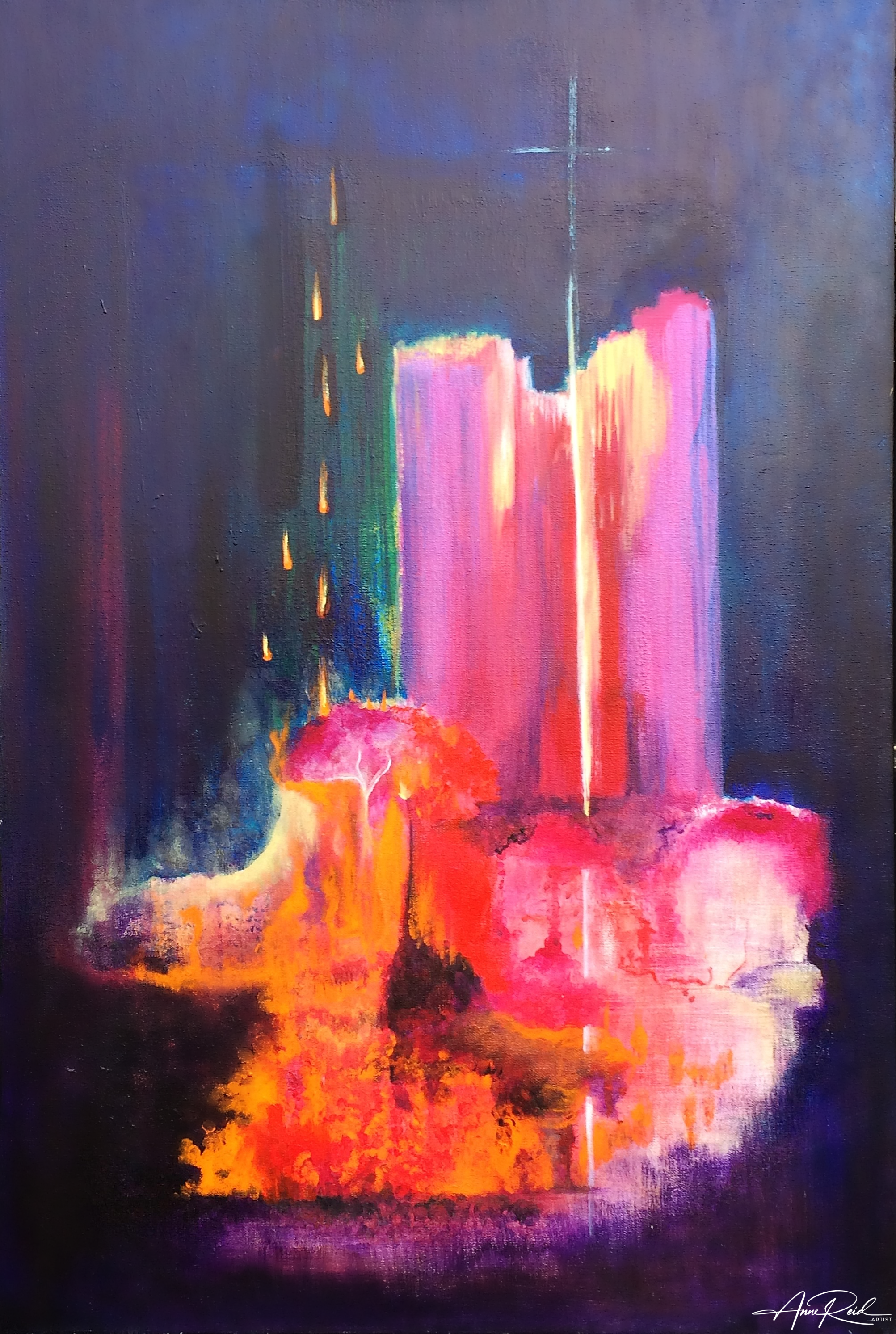
Seed of the Woman is the clearest example of that.
I was working the way I normally work — abstractly, without a finished image in my head. I start with color, gesture, water, movement, disruption. I put the paint down, move it around, interfere with it, wipe it back, build it again, and keep watching until something begins to show itself. At that time I was working on three 24 x 36 canvases together: Seed of the Woman, Deluge, and Golgotha. It was the first time I was really handling canvases of that size in that way. A lot of it was experimentation. I liked the colors. I wanted the scale. That was enough to begin.
Then I started seeing the drips. Not pretty drips. Not decorative drips. They felt like something was falling. The whole painting began to take on an apocalyptic weight — fire raining down from heaven to earth. Even now, that is still how it reads: a painting of vertical intervention. The whole field is saturated in dark blue, violet, and indigo, but it is not empty darkness. It feels occupied. Pressured. Then that narrow, searing line drops through the composition like a wound of light, resolving near the top into the Cross. Below it the painting becomes molten — hot pink, ember-orange, flame-red, white fire — as though something is being judged, melted down, or unseated.
I remember looking at it and thinking: What is this? What am I looking at? And then the scripture came: I saw Satan fall like lightning.
I did not feel bold about that. I felt troubled. I was genuinely uneasy — not because there was anything wrong with the painting, but because I did not yet have the framework to understand what had come through it. People prefer comfort. They do not usually rush toward a painting that carries judgment, overthrow, and the destruction of evil. So I was careful with it. I kept it close and kept working.
As I did, the structure became clearer. There was a rising pink form. There was the Cross. There was the sense of a church-like structure — not tame or decorative, but a whole field of resistance being broken open by holy presence. Not Satan as a character, exactly, but satanic rule losing height. Something that had occupied the high place being struck through and brought down.
I was thinking about Faith Marie Baczko and the authority bound up in the woman. About the ancient word in the garden — that the enemy would be defeated through the seed of the woman. About Barbara Yoder and what it looked like to see a woman carrying genuine apostolic authority. I could not yet put it all together properly. But I could feel that the painting was carrying both the Cross and something distinctly feminine in its force.
The Cross in the painting never felt like a polite church symbol. It felt like a weapon. More than that — like the pointed heel of a woman's shoe driving straight down through the head of the enemy.
That is how I saw it. And because I saw it before I could explain it, I was afraid of it. Now, years later, I can say plainly: there was nothing wrong with me and nothing wrong with that painting. The painting was right. I simply did not have the framework yet. Since then there have been years of prayer movement language, apostolic teaching, Barbara Yoder, Dutch Sheets, declarations, and deepening conversation around Ekklesia as a governing people rather than simply a gathered congregation.
Glory Cluster
Open edition fine art print by Anne Reid Artist
Glory Cluster came from a different place, but it belongs in the same conversation.
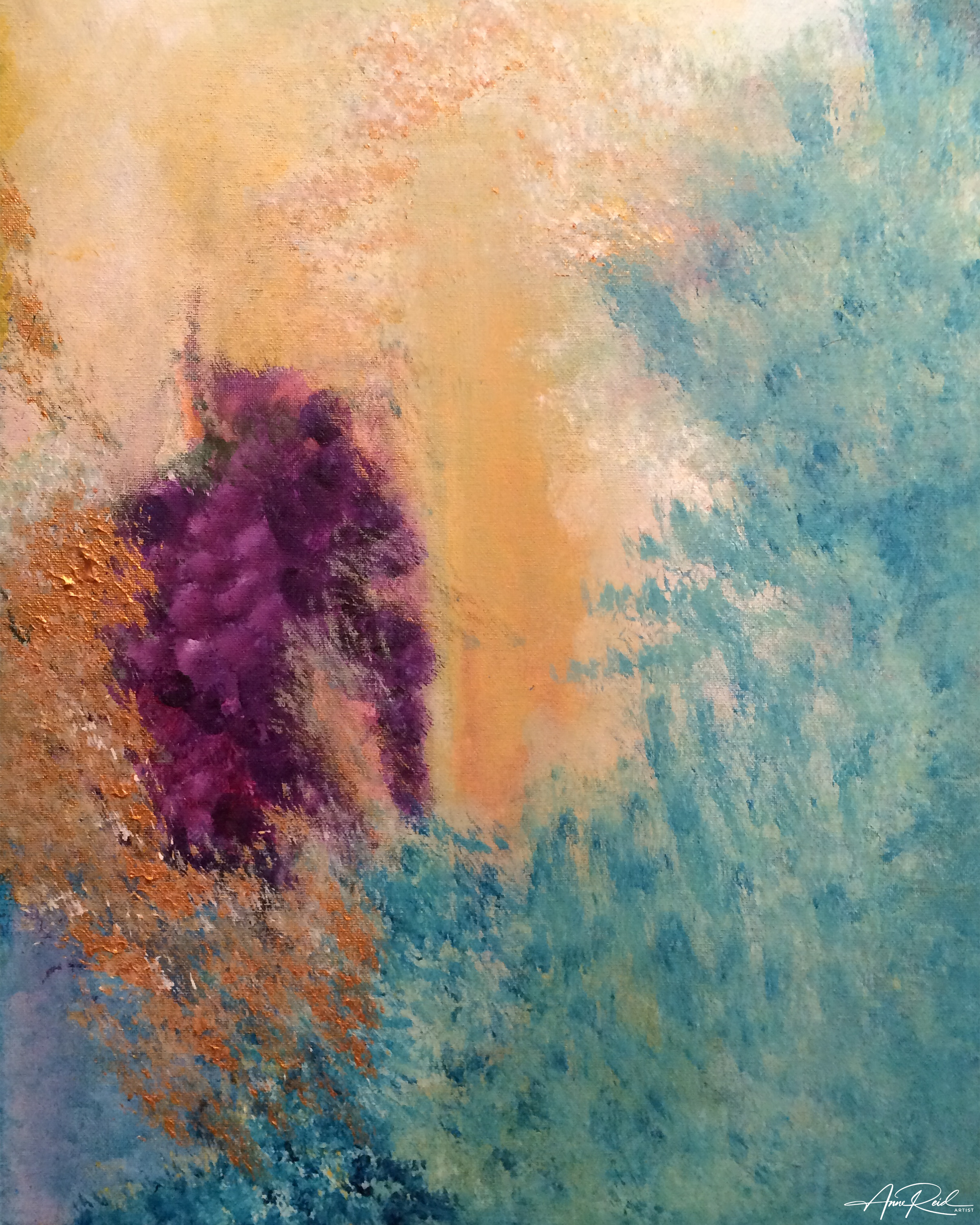
I painted it in the House of Prayer at Catch the Fire in Toronto. Quick. Loose. A few hours. I chose the colors and went at it. And as I was painting, I saw the grapes — the cluster. At that time there was teaching around the cluster and the wine: the richness is not in the isolated grape but in what happens when grapes are together, pressed together, crushed together. From that comes the wine.
That struck me because it did not come naturally to me. I am by nature independent. I think in terms of my own responsibility, my own path, my own work. So this was not a flattering thought. It was corrective. The richness is not in the lone person. The richness is in the joined thing.
The painting carries that. It is doing almost the opposite kind of work from Seed of the Woman. Where Seed of the Woman is vertical, piercing, and judicial, Glory Cluster is organic, atmospheric, and communal. The purple form is dense but not rigid. It gathers rather than towers. It reads less like one object dominating a field and more like a concentration of presence — a thickening or ripening of glory inside a wider atmosphere of pale gold, turquoise, and light.
Which is beautiful until you actually have to live it. Because this gets into relationship, and relationship is exactly where warfare hits hardest. It is one thing to speak about body life, community, Ekklesia, alignment. It is another thing to stay in the pressure of it — where people misunderstand one another, disappoint one another, wound one another, and still have to work things through. That is where the cost is. That is where the real forming happens.
The understanding I needed to see this clearly came through a stream over many years — through spiritual mothers in my church community, through apostolic voices like Barbara Yoder speaking about leadership shifting away from one personality at the center toward teams joined in vision, heart, mind, and spirit, with Jesus at the center. Not celebrity Christianity. Not one voice. A cluster.
Overthrow and formation
These two paintings are not saying the same thing. But they belong together.
Seed of the Woman carries overthrow — the fall of the enemy, the decisive breaking of a false dominion.
Glory Cluster carries formation — the costly joined life that has to come into being afterward.
Somewhere between overthrow and formation, between lightning and cluster, between the heel and the gathered grapes, is where the Ekklesia becomes real. Not as language. Not as a conference theme. Not as a trend in the apostolic world. As a people who discover, often after the fact, what God was already saying and building.
For the past three years the word the Lord has been speaking to me is this: overcoming victory. Not denial. Not escape. Not pretending the shaking is not real — the shaking is real. We are living through the shaking of structures, systems, assumptions, old wineskins, old church paradigms, and things people once thought were permanent.
But the shaking is not the whole story.
The Lord is building His Ekklesia. Not a crowd. Not a personality cult. Not a Sunday performance. A people under His headship — who know who they are in Christ, who are rooted and grounded in His love, and who are learning to stand, speak, and move in the authority He has given them.
That is why these paintings matter to me now in a way they did not even when I first made them. They were both telling the truth ahead of me.
And in a time when everything that can be shaken is being shaken, He is building His Ekklesia — and the gates of hell shall not prevail against it.
You can take that to the bank.
Further reading: What Is Prophetic Art?
View the prints: Seed of the Woman | Glory Cluster
For questions about a specific print or to discuss a piece for your space, contact me: info@annereidartist.com