


Seed, Gate, Flame: Decoding Anne Reid’s Signature Motifs for Inspired Interiors
Mar 21, 2026
Seed, Gate, Flame: Three Motifs in Prophetic Art and How They Shape a Room
By Anne Reid Artist
About the author: Anne Reid Artist is a contemporary abstract painter whose work explores prophetic art, symbolic visual language, and the spiritual atmosphere of interiors through color, movement, light, and form.
Seed, Gate, and Flame are three recurring visual motifs in my prophetic art — not planned symbols, but recurring languages that emerge through the painting process itself. Seed speaks of beginning and quiet promise. Gate suggests threshold and transition. Flame brings activation, energy, and revelation. Together they give collectors, designers, and anyone placing art with intention a usable language for what a room is being asked to hold.
Patterns and palettes can harmonize a room, but motifs do something subtler: they supply meaning. When a painting's internal logic mirrors a space's purpose — quiet reflection in a bedroom, kinetic energy in a hotel lobby — the artwork becomes indispensable rather than decorative. Because my work remains abstract rather than illustrative, these motifs leave room for interpretation while still giving the room a deeper internal logic. That balance is exactly what many contemporary interiors are asking for.
For more on the spiritual foundation behind this work, read What Is Prophetic Art?
What does the Seed motif mean in prophetic art?
Seed is the motif of beginning, promise, and embryonic energy — growth not yet fully announced. It carries quiet optimism without urgency, which makes it especially effective in spaces meant to restore rather than stimulate.
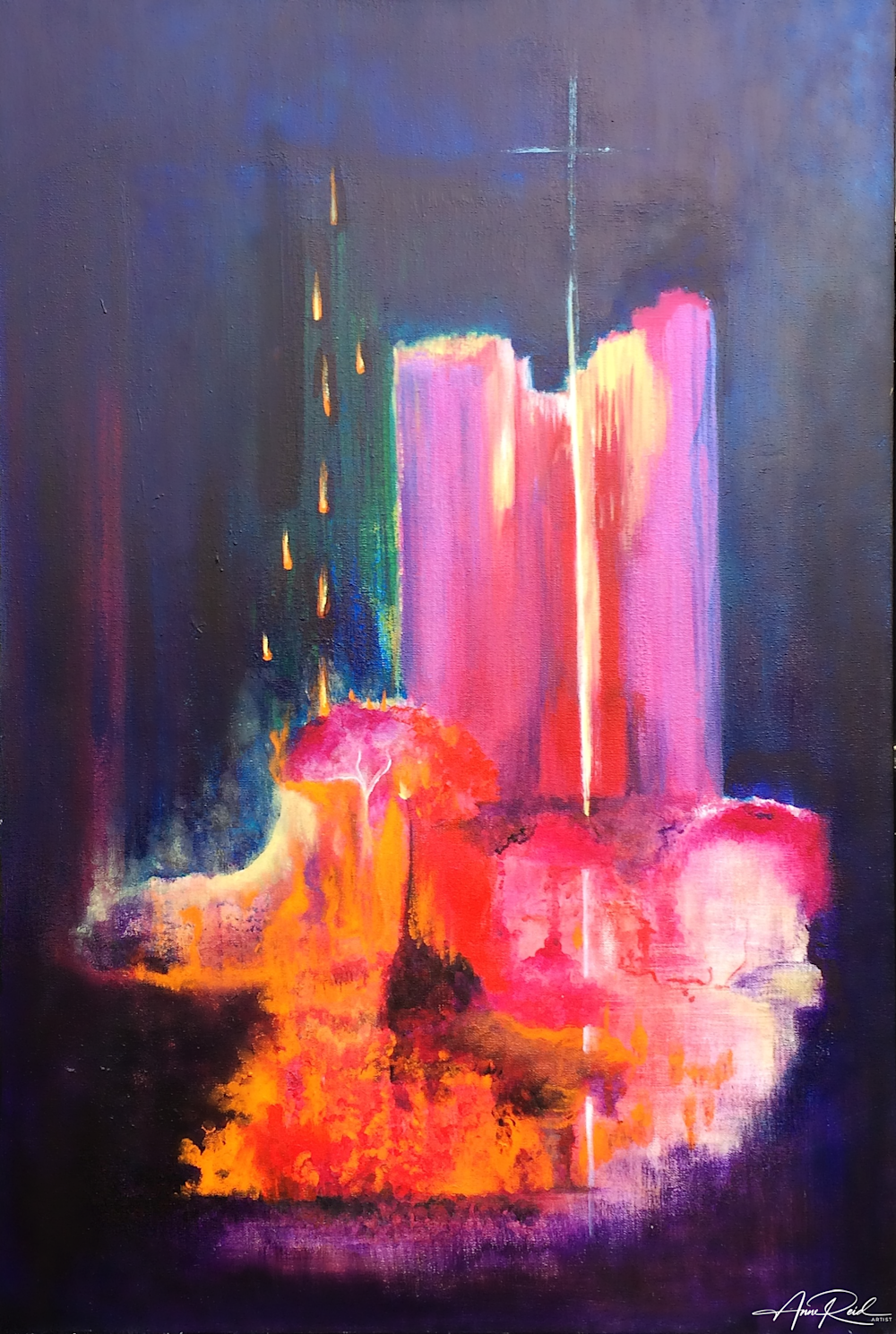
The Seed motif appears most explicitly in Seed of the Woman, and echoes through Herald 117. When I am working in this register, you will often notice concentric forms, a gentle gravitational pull toward the center of the canvas, and gradients of pinks, corals, and warm light. For me, Seed is about ideas just before they surface — growth that has not yet announced itself.
Why does Seed work well in interiors?
- Mood anchor: The gentle pink-orange spectrum reads as both hopeful and refined, pairing well with champagne metals, pale terrazzo, and soft gray upholstery.
- Scale play: In smaller formats, Seed works like a gemstone accent. At larger scale, it behaves more like an interior sunrise.
- Wellness resonance: Collectors and designers drawn to biophilic spaces often respond instinctively to the organic geometry. Placing these pieces near live greenery can amplify that effect.
Best rooms for Seed
Bedrooms, wellness spas, meditation corners, quiet sitting rooms, and reception areas that need calm optimism all suit Seed especially well.
What does the Gate motif mean in prophetic art?
Gate is the motif of threshold, movement, and passage from one season or state into another. These works hold tension and release at the same time — there is movement, but also balance. That combination makes Gate pieces particularly effective in transitional spaces where flow matters more than stillness.
The Gate motif comes into focus most clearly in Herald 117, where a delicate Star of David hovers above cascading blues and scarlets, linking Canada to Jerusalem's ancient East Gate. When I paint Gate imagery, I am not thinking of doors so much as passages — the moment where one season yields to another.
Why does Gate work well in interiors?
- Transition zones: Corridors, entry halls, and elevator lobbies are literal thresholds. Gate-themed works reinforce the spatial narrative already happening there.
- Architectural dialogue: Pairing these pieces with arched mirrors or door moldings creates a subtle conversation between art and architecture.
- Color bridge: Verdigris, indigo, and maroon often harmonize adjacent rooms with different color stories, acting as a chromatic mediator.
Best rooms for Gate
Entry halls, passageways, elevator lobbies, corridors, and architectural transition zones are especially strong placements for Gate-centered works.
What does the Flame motif mean in prophetic art?
Flame is the motif of dynamic illumination, activation, passion, and revelation. These works do not sit quietly on a wall. They activate the space around them.
The Flame motif arrives through vertical streaks, slash-marks, and bursts of luminous white or gold. You will find it in works like Oil Lamps, Glory Storm, and the fiery core of Angels 3. When I am painting Flame, the emphasis is always movement — upward, outward, urgent. From an interior perspective, its real power is kinetic energy.
Why does Flame work well in interiors?
- Energy zones: Restaurants, creative studios, music lounges, and co-working spaces benefit from the sense of motion Flame provides.
- Layered lighting: A dimmable picture light allows metallic pigments to shift as illumination changes, reinforcing the sense of heat and motion throughout the day.
- Palette punctuation: Even within restrained schemes, a Flame piece can serve as a controlled burst of color — a visual exclamation point.
Best rooms for Flame
Living rooms, hotel lounges, studios, restaurants, music spaces, and any room needing activation or upward movement suit Flame especially well.
How can Seed, Gate, and Flame work together in one space?
While each motif stands alone, they can also be deployed as a visual progression: Seed (potential) → Gate (transition) → Flame (activation).
In a boutique hotel, this might mean Seed imagery in guestrooms, Gate works in corridors, and Flame pieces anchoring communal areas. The narrative unfolds without explanation. Guests feel the shift even if they never consciously name it. In that way, the artwork becomes a silent guide — shaping experience rather than announcing itself.
At a glance: how the three motifs differ
| Motif | Best location | Complementary materials | Spatial effect |
|---|---|---|---|
| Seed | Bedrooms, wellness spas, meditation corners | Brushed brass, linen, raw maple | Calms and centers |
| Gate | Entry halls, passageways, elevator lobbies | Honed limestone, matte black steel | Guides and balances |
| Flame | Living rooms, hotel lounges, studios | Smoked glass, velvet, aged leather | Activates and invigorates |
How to explain these motifs to clients
Abstract art can feel inaccessible until there is a handle. These are the phrases I find most useful:
- Seed: "This piece feels like the moment just before something begins — still, but charged."
- Gate: "Notice how the central form draws your eye forward. It is an invitation to move, both physically and psychologically."
- Flame: "The gold is not ornamental. It responds to the room's light throughout the day, almost like a hearth."
These small narratives help people connect emotionally to abstract work — which increases confidence and commitment at the point of decision.
Practical considerations for placing these prints
- Print vs. original: Archival fine art prints offer flexibility for larger projects without sacrificing the depth created by layered glazing.
- Framing: Seed works soften beautifully in white oak. Gate pieces often prefer slim black metal. Flame thrives in shadow-box frames that allow air and light around the work.
- Mounting height: Eye-level placement suits Seed and Gate. Hanging Flame slightly higher reinforces upward movement and visually lifts ceilings.
- Collection coherence: When mixing motifs across rooms, consistent framing keeps the narrative intentional rather than accidental.
Why motifs matter: a closing thought
In a marketplace crowded with imagery, the work that lasts is distilled rather than descriptive. Seed, Gate, and Flame are not decorative gestures. They are visual verbs — to begin, to pass, to burn.
When you are placing art in a home, a spa, or a hospitality project, consider not only what hangs on the wall but why. Let a Seed invite stillness. Let a Gate suggest movement. Let a Flame kindle warmth. The room will feel the difference long before anyone explains it.
To explore the deeper spiritual source behind these motifs, read What Is Prophetic Art? or browse the Abstract Art Prints collection.
Frequently asked questions
Are Seed, Gate, and Flame fixed symbols?
Not exactly. They are recurring visual languages rather than rigid symbols. Because the work remains abstract, they allow personal interpretation while still carrying consistent internal meaning.
Can these motifs be used together in one project?
Yes — and they work especially well as a progression. Seed for stillness and beginning, Gate for transition and movement, Flame for activation and energy.
Which motif is best for calming spaces?
Seed is usually the strongest fit for calming, restorative spaces. It carries promise and quiet optimism without urgency — making it well-suited to bedrooms, spas, and prayer corners.
Which motif is best for movement and energy?
Flame is best when a room needs activation, upward movement, and a stronger kinetic presence — restaurants, studios, and communal living spaces in particular.
Where can I see these prints?
Browse the full collection at Abstract Art Prints, or for help choosing a piece for a specific space, contact me: info@annereidartist.com