


Yellow Wood: A Study in Scale, Structure, and Placement
Mar 21, 2026
Yellow Wood
By Anne Reid Artist
About the author: Anne Reid Artist is a contemporary abstract painter whose work explores prophetic art, presence, healing, and the spiritual life of the studio through color, movement, and form.
An architectural-scale painting refined through time and installed in a cathedral timber home in Muskoka, Ontario.
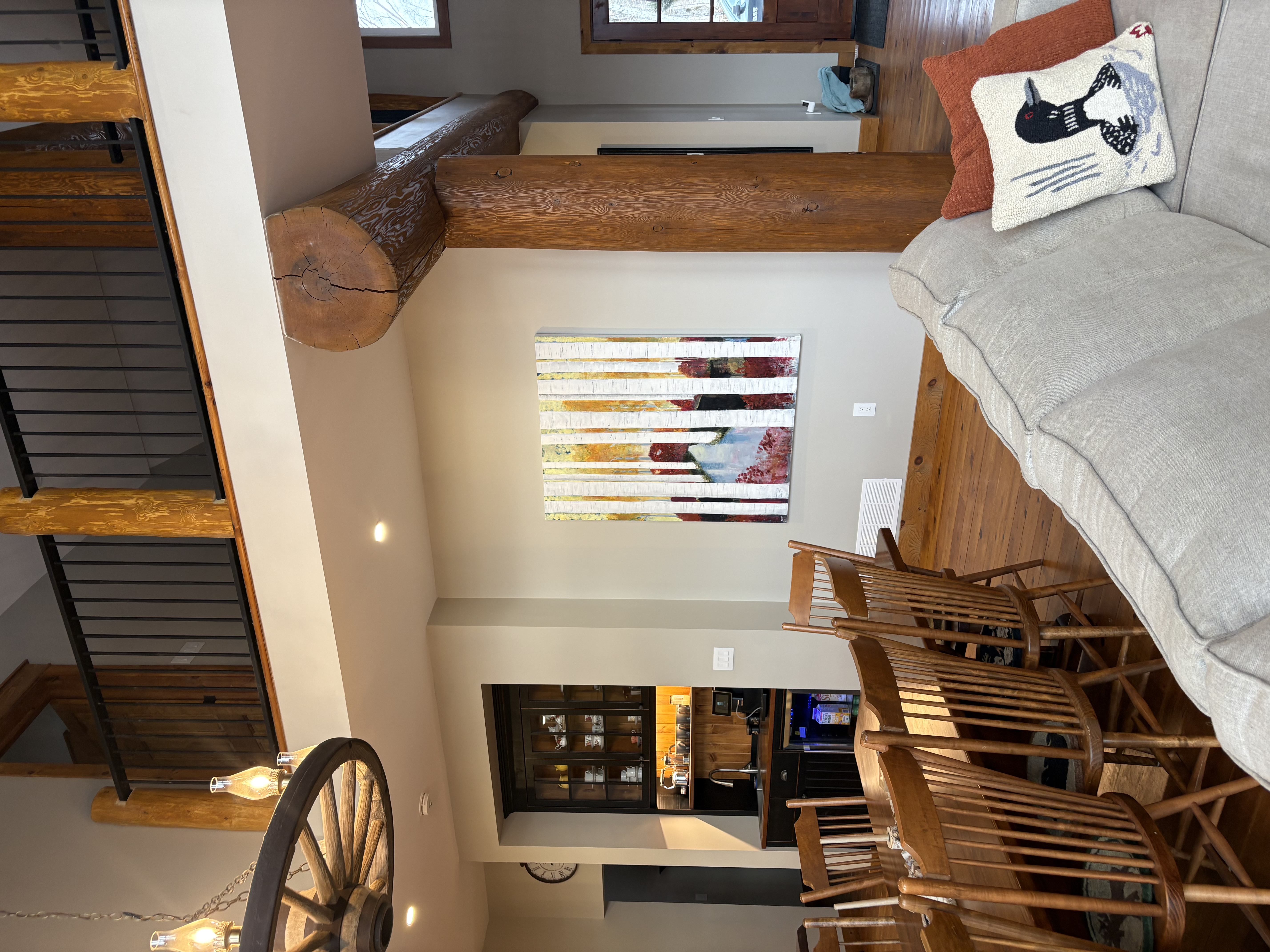
Yellow Wood is a 48 × 60 acrylic on canvas that began as a commission, evolved through restraint and distance, and ultimately found its place in a cathedral-ceiling timber home in Muskoka, Ontario. Installed in an open-concept living and dining space, the work anchors the room rather than decorating it — the vertical birch forms echoing the structural beams, the central pathway drawing the eye inward, the autumn palette warming the wood interior without disappearing into it. At this scale, the painting holds presence without overwhelming its environment. It functions as part of the room's architectural rhythm.
This article explains how the painting changed after an unfulfilled commission, why its final form required time and distance, and what this installation reveals about placement, scale, and architectural fit.
Why does Yellow Wood work so well in this space?
It works because the painting and the room share the same visual logic: vertical structure, measured openness, and enough scale to hold the volume of the space.
The vertical birch forms echo the timber beams. The open negative space allows the architecture to breathe. The autumn palette warms the wood interior without collapsing into it. Scale and proportion hold the composition steady within the volume of the room.
What makes the fit successful?
- The 48 × 60 scale is large enough to hold the wall and room volume.
- The vertical composition echoes the cathedral timber structure.
- The central pathway creates depth and inward movement.
- The palette warms the interior without visually disappearing into the wood.
- The painting adds presence without crowding the architectural space.
How did the commission redirect the work?
The painting began as a commissioned birch composition in 2019. Two versions were created under specific direction. Neither was accepted. Shortly afterward, the world shifted into lockdown.
What initially felt like failure proved to be refinement. Once the constraints of the commission were removed, the work was free to clarify its own structure. The composition opened. The color deepened. The pathway became central rather than incidental.
Some works require distance from expectation before they reveal their final form.
What changed once the constraints were removed?
- The composition became more open.
- The pathway moved into a central structural role.
- The color gained depth and maturity.
- The painting was able to become more fully itself.
What do the painting and the house have in common?
They developed on parallel timelines and arrived at resolution through the same kind of patience, structure, and disciplined execution.
While the painting matured in the studio, its future environment was under construction. The timber home required vision, permitting, delay, and disciplined execution — built beam by beam. When one reached resolution, so did the other.
Yellow Wood does not feel dropped into the home after the fact. It feels resolved with it.
How do overflow and discipline work together in a large-scale installation?
As a colorist, my instinct is boldness. Original works begin as overflow — intuitive, layered, and unconcerned with interior trends. Yet when a painting enters architectural space, discipline becomes essential. Scale, tonal balance, and structural rhythm determine whether a work elevates a room or competes with it.
In this installation, color carries conviction while remaining livable. The composition neither dominates nor recedes. It holds its place.
What does discipline mean in placement?
- Choosing a size that suits the architecture.
- Maintaining tonal balance within the room.
- Allowing the composition to support, not fight, the space.
- Letting bold color remain livable.
Why placement matters as much as the painting itself
Not every painting belongs in every space. Yellow Wood was not rejected — it was redirected, refined until its structure aligned with architecture capable of holding it. In its current setting, the work functions as part of the home's spatial language: an element of rhythm, depth, and quiet presence.
If you are working with a large-scale space and want to understand how scale, structure, and placement come together, the Sizing and Placement Advice page is a good place to start. To understand the spiritual dimension of this work, read What Is Prophetic Art? For commissions or questions about architectural fit, visit the contact page.
Frequently asked questions
Was Yellow Wood originally painted for this house?
No. It began as a 2019 commission under different constraints and only reached its final form later.
Why does the painting suit a cathedral timber home so well?
Because the vertical birch forms echo the timber beams, the scale suits the room volume, and the palette warms the interior without overwhelming it.
Is this article mainly about the painting or about placement?
Both. The painting matters, but the central lesson is that scale, structure, and placement determine whether a work truly belongs in a room.
What does this installation show about buying art for large spaces?
That architectural fit matters as much as beauty. A strong painting must also suit the structure, rhythm, and visual scale of the room it enters.