


The Apple: A Heavenly Tribute to Israel as the Apple of God’s Eye and His Eternal Promise
May 31, 2026
The Apple
By Anne Reid Artist
About the author: Anne Reid Artist is a contemporary abstract painter whose work explores prophetic art, presence, healing, and the spiritual life of the studio through color, movement, and form.
I saw a NASA photograph of the Helix Nebula — a dying star that shed its outer layers into space, forming concentric rings of deep blue, gold, and fire. Scientists and the public had nicknamed it the Eye of God. And when I saw it, I thought immediately of a phrase from the Hebrew Bible: the apple of God's eye.
Then I saw the stars scattered across that deep blue field, and I thought of the covenant God made with Abraham — that his offspring would be more numerous than the stars in the sky. A promise made to one man, about one people, that the whole world has felt.
I thought about the end times. About the rising tide of antisemitism in the world. About a people who have been hated, scattered, persecuted, and survived — because God said they would.
Israel is something God Himself taught me about. Over years of prayer, He gave me a love for her people and a burden to pray for them. As a Christian artist, this series is my platform and my voice. This is how I get to say what I believe — not with argument, but with paint.
The Apple is part of the Israel Series — a body of prophetic art bearing witness to what God says about the land of Israel, the Jewish people, and the promises He has made concerning their destiny that are not yet fully fulfilled. You can explore all the works in the Israel Series here.
What does "the apple of God's eye" mean in Scripture?
Four passages in Scripture use the specific phrase translated as "the apple of the eye," three of them describing God's relationship with His people directly.
- Deuteronomy 32:10 — "He found him in a desert land, in the howling waste of a wilderness; he shielded him, he cared for him, he guarded him as the apple of his eye."
- Psalm 17:8 — "Keep me as the apple of your eye; hide me in the shadow of your wings."
- Zechariah 2:8 — "...for whoever touches you touches the apple of his eye."
- Proverbs 7:2 — "Keep my commands and you will live, and guard my teachings as the apple of your eye."
The Zechariah passage is particularly significant. It was spoken to Jewish exiles who had just returned to Jerusalem from Babylonian captivity — a small, vulnerable people surrounded by hostile empires. God's word to them was not general encouragement. It was a declaration of divine identification: whoever touches you touches Me. An attack on His people is a direct, personal attack on Him.
The Hebrew word ishon — "little man of the eye" — makes this even more precise. The pupil is the most sensitive and delicate part of the body. It is also the place where you see yourself reflected when you look into someone else's gaze. To be the apple of God's eye is to live inside that reflection. To be seen at that distance. To matter that much.
Why does this painting stand with Israel?
God chose this nation for Himself out of all the nations — not because they were the largest or the strongest, but because He set His love on them. And through them, He intended to bless the whole earth. In Genesis 12:3, He tells Abraham: "I will bless those who bless you, and whoever curses you I will curse; and all peoples on earth will be blessed through you." Paul identifies that promise in Galatians 3:8 as the gospel announced in advance — the good news that all nations would be included in the blessing of Abraham through faith.
The roots of Christianity are Hebrew. Everything we hold — the adoption, the covenants, the law, the temple worship, the promises, the patriarchs, the Messiah Himself — came to us through Israel. Paul names these gifts explicitly in Romans 9:4–5. In Romans 15:27 he calls it plainly: a spiritual debt. Gentile believers were grafted into something. We did not replace it.
There are Christians who believe the church has replaced Israel in God's purposes. I understand that reading. This painting is not an argument against it. It is simply standing somewhere else — with Paul in Romans 9–11, with the conviction that God has not rejected His people, that the natural branches were broken off for a season but the root remains, and that the promises Scripture makes about Israel's future are still coming.
I think of it through the fifth commandment: honour your father and your mother. Israel is, in a real sense, the father and mother of the faith. God promised to turn the hearts of the fathers to the children, and the children to the fathers. That turning is still in process. This series is part of how I participate in it.
The eye is watching — and the watching has consequences
When I first saw the Helix Nebula, what struck me was not only its beauty. It was the sense that it was looking back. The cosmos arranged into an eye. And an eye that watches does not watch neutrally.
Zechariah 2:8 is not only a declaration of tenderness. It is a warning. Whoever touches you touches the apple of His eye. There is a consequence built into that sentence. God does not observe the treatment of His people from a distance and feel nothing. He takes it personally. He always has.
In Matthew 25, Jesus describes the judgment of the nations — sheep on the right, goats on the left. The dividing line is not theology. It is treatment. What did you do for the least of these my brothers? Many theologians read "these brothers" as the Jewish remnant — the persecuted people of God in the last days. The nations are judged on how they responded in their hour of need. Fed or ignored. Sheltered or turned away. Blessed or cursed.
We are living in a moment of rising antisemitism. The hostility is not new — it has broken out in every generation — but the current wave is visible, accelerating, and global. I am not painting from the outside of that reality. I am painting from inside a conviction that God sees it, that it matters to Him in the most personal terms possible, and that how we respond — as individuals, as the church, as nations — is not a peripheral question. It is, according to Scripture, among the most consequential ones.
What is the visual inspiration behind the painting?
The Helix Nebula is a planetary nebula located approximately 650 light-years away in the constellation Aquarius — the remnant of a dying star that shed its outer layers into space, creating concentric rings of luminous gas in deep blues, oranges, and golds. Astronomers and the public have long nicknamed it the "Eye of God." A vast, cosmic form that looks unmistakably like a watching eye looking back.
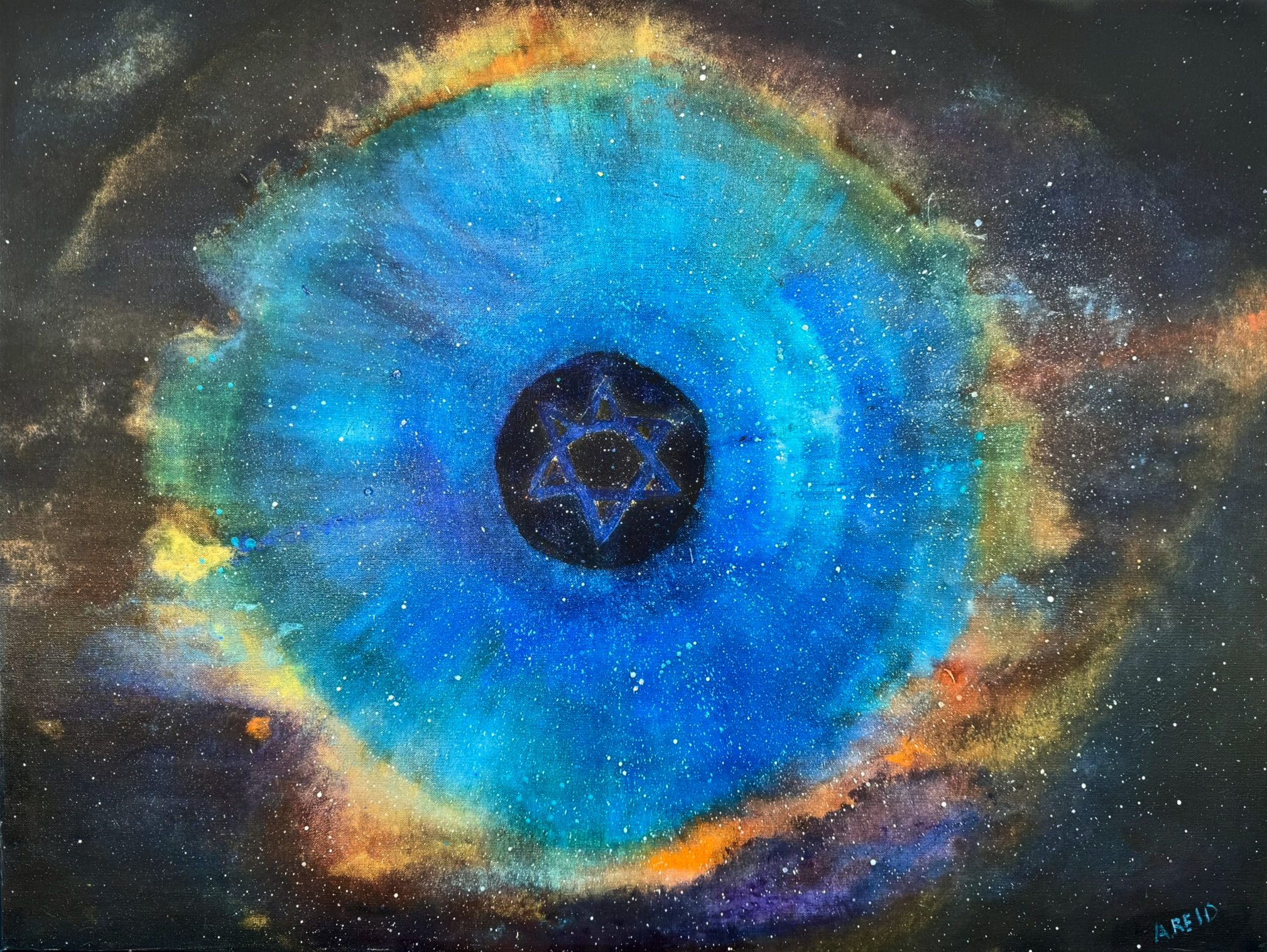
The painting works directly from that image. The concentric rings of the nebula structure the entire composition — deep luminous blue at the center, warm gold and orange forming the outer corona, white star-spatter giving the blue field genuine depth. The canvas does not frame the nebula. It opens into it. The edge dissolves into dark space, as if the eye extends beyond what can be seen.
The deep celestial blue is not decorative. It is cosmic in register and intimate in meaning at the same time: the vastness of God's gaze and the closeness of it, held together in color. And those stars scattered across the blue — they are not only beautiful. They are the covenant. As numerous as the stars in the sky. God said it to Abraham, and He has not taken it back.
Why does the Star of David appear at the center of this work?
The Star of David — the Magen David, "Shield of David" — carries a long and layered history. Two equilateral triangles superimposed, forming a hexagram. Used as a symbol of Judaism since at least the 17th century, adopted by the Zionist movement in 1897, used by the Nazis to mark Jewish people for persecution, and now at the center of the flag of the State of Israel. Its history alone carries weight.
In The Apple, the star is present for its deepest theological meaning: one triangle points upward, one points down. Heaven reaching toward earth. Earth reaching toward heaven. The covenant as geometry — the same covenant that has held through exile, diaspora, persecution, and return, and that Scripture says will hold until its final fulfillment.
In the painting, the star sits inside the dark central circle — the pupil — rendered in dark blue-black, almost submerged within the void rather than displayed above it. That placement is not accidental. The covenant sign is not announced on the surface. It is held at the deepest point of the gaze, inside the watching itself.
At the center of the deep blue field, the star holds still. Everything moves around it. The covenant God made with Israel does not shift with history or circumstance. It holds — even when the people are in exile, even when the promises are not yet fully fulfilled, even now.
What are the unfulfilled promises this painting stands within?
The Israel Series is rooted in a conviction that several of God's unconditional promises to national Israel remain awaiting complete fulfillment. These are not peripheral promises. They are the structural covenants of Scripture.
- The Land Covenant — God promised Abraham an everlasting possession of land. Israel has never fully occupied that territory in its complete biblical extent. The promise is not exhausted.
- National Restoration and Security — The prophets promised a complete regathering of the Jewish people from all nations, accompanied by permanent security and the end of war. The modern State of Israel exists. That final peace does not yet.
- The New Covenant — Jeremiah 31 describes a covenant written on hearts, where all of Israel collectively knows God. Paul in Romans 11 holds that this national, corporate fulfillment for Israel as a distinct people is still coming.
- The Davidic Kingdom — God promised David an everlasting throne. The visible, earthly reign bringing global justice and peace from Jerusalem remains, in Paul's eschatology, still ahead.
The Apple does not argue these promises. It holds them. The deep blue, the watching eye, the covenant star at the center — they speak of a God whose gaze has not moved from His people, whose word has not returned void, and whose promises are not finished.
Where does The Apple belong in a home or sacred space?
The Apple carries intimacy, covenant weight, and eschatological seriousness. It is a watching, sustaining presence rather than a high-energy or confrontational work. It belongs in spaces of prayer, intercession, and reflection — a prayer room, a bedroom, a home office, a sacred corner where someone regularly brings the world before God.
It speaks particularly to those who carry a burden for Israel and the Jewish people, or who pray into the unfulfilled promises of Scripture. The deep blue palette holds well against neutral walls and warm wood tones. The Star of David at the center is a steady visual anchor for prayer.
For such a time as this
I am aware that God is watching me, too.
Mordecai's words to Esther have never left me. She had a platform — a position she had not sought, in a palace she had not chosen, at a moment she could not have engineered. And the question put to her was simple and devastating: what will you do with it? If you remain silent, deliverance will come from somewhere else. But you will have missed the moment you were made for.
I am not Esther. But I am an artist with a platform, a brush, and a conviction that God has not finished with Israel. And I live in a moment when antisemitism is rising, when the church is divided on what it owes the Jewish people, and when silence is increasingly a choice with consequences.
This is what I can do. This painting. This series. This voice.
Mordecai was clear that God's purposes for Israel would not be stopped by one person's silence. Deliverance would arise from another place. But that was not an argument for staying quiet. It was a call to recognize the weight of the moment — and to step into it rather than past it.
If this painting has found its way to you, perhaps that is its own small version of the same question. What will you do with it? Where will it hang? Who will see it? What will it carry into the room?
The Apple is available as an open edition fine art print. View print sizes and ordering details here. To explore the full Israel Series, including all works in this collection, visit the series page.
To understand more about how prophetic art is made and what distinguishes it from other Christian or spiritual art, read What Is Prophetic Art?
For questions about this work, placement advice, or commission inquiries, visit the contact page.
Frequently asked questions
What does the title refer to?
The title comes from the Hebrew biblical phrase ishon ayin — "little man of the eye," translated as "the apple of the eye." It appears in Deuteronomy, Psalms, Zechariah, and Proverbs as an expression of God's most intimate, protective attention toward His people.
Is this painting about replacement theology?
No. This painting stands with the conviction that God's covenant with the Jewish people concerning the land and their national destiny has not been revoked. It is not an argument — it is a witness to what Scripture says about Israel and the promises God has made concerning them.
What is the Israel Series?
The Israel Series is a body of prophetic art bearing witness to what God says about the land of Israel and the Jewish people — the covenants He made with them, the promises not yet fully fulfilled, and the role Israel has played and will yet play in God's redemptive purposes for the world. Explore the full series here.
What inspired the deep blue and cosmic imagery?
A NASA photograph of the Helix Nebula — nicknamed the "Eye of God" — and the immediate connection to the scriptural phrase "the apple of God's eye." The stars scattered across the nebula's deep blue field brought to mind God's covenant promise to Abraham that his offspring would be more numerous than the stars in the sky.
What does the Star of David represent in this painting?
It carries its full historical weight as the symbol of the Jewish people and its deepest theological meaning: heaven reaching toward earth, earth toward heaven, the covenant held in one form. In the painting it sits submerged within the dark central pupil — held at the deepest point of the gaze, not announced on the surface.
What kind of space suits this painting?
Prayer rooms, spaces of intercession, bedrooms, and home offices — anywhere someone carries a burden for Israel, prays into Scripture's unfulfilled promises, or wants to rest in the reality of God's covenant faithfulness toward His people.
What is "for such a time as this"?
It is Mordecai's words to Esther in Esther 4:14 — a call to recognize that your position, your platform, and your moment in history are not accidental, and that silence in the face of injustice toward God's people is itself a choice with consequences.