



I am More Surprised than You Are
Jun 02, 2026
I was listening to Lance Wallnau's broadcast on UAPs and Genesis 6 when something he said about Mount Hermon arrested my attention — because I have a painting called Transfiguration, and I did not have the complete understanding of what that biblical moment encompassed. Lance Wallnau is a theologian and cultural commentator known for connecting current events to biblical frameworks rather than the news cycle. Episode 2127 — The Strange Pattern in UFO Reports That Matches Genesis 6 — is where this rabbit trail begins. And it begins, as so much does for me, with a painting that arrived before the understanding.
Two Voices, One Framework
Lance Wallnau takes the sensationalism of the UAP news cycle and returns it to the Bible. What pilots and senators are calling unexplained, the biblical worldview has always had categories for — rebellious spiritual beings, the intersection of dimensions, powers that claimed jurisdiction over the earth. The UAP files are not the story. They are a sign pointing to a story the Bible has been telling since Genesis 6. Lance draws throughout Episode 2127 on the scholarship of Michael Heiser, a Hebrew Bible scholar whose landmark book The Unseen Realm argues that modern Christians have flattened the Bible's supernatural worldview and need to recover it.
The second voice is Barbara Yoder, an apostolic leader and teacher based in Ann Arbor, Michigan, whose Genesis teaching I heard the same week. Where Lance takes the news back to Scripture, Barbara takes the fear that the end is coming and turns it toward its proper object. Not dread. Expectation. The best days of the church are ahead because the restoration of all things — Acts 3:21 — is the direction history is moving. In her Genesis teaching she makes the case that God's first revealed action toward a devastated earth is to restore it. Genesis 1 is already a restoration story. That intention has never changed.
Together they form a single framework: the days of Noah are repeating, the powers of wickedness are becoming visible, and the Ekklesia — the governing arm of Christ on the earth — is the appointed response. Not a survival community. Not a defensive remnant. The instrument of restoration, advancing against gates that cannot hold.
As It Was in the Days of Noah
Jesus said it plainly in Matthew 24:37: the days before His return would replicate the days of Noah. Not approximately. Rick Renner, a New Testament Greek scholar and teacher, documents in his October 2023 teaching letter that the Greek means just exactly as it was, accordingly it will be. Six conditions from Genesis 6 duplicated: exploding population, sexual perversion, dark spiritual activity, the tampering with what it means to be human, continual evil, widespread violence. Anyone paying attention to the present moment will recognize all six.
Genesis 6 is the story of what happened after Genesis 3:15 — after God declared that the Seed of the Woman would crush the serpent's head. If the enemy knew the Seed was coming through a human bloodline, the strategic move is to corrupt that bloodline before the Seed arrives. Ancient Jewish tradition, preserved in 1 Enoch and known to the first-century church, says 200 angels — the Watchers — descended on the summit of Mount Hermon and swore a mutual oath. They produced offspring, the Nephilim, that were not fully human. The image of God in humanity was being systematically defiled. The Dead Sea Scrolls contain Aramaic Enoch fragments dating to around 200–150 BC. Jude directly quotes Enochic material. This is not fringe theology. It is Second Temple tradition the New Testament writers knew and drew on.
Noah was called righteous in his generation. I have read that not only as moral standing but as something more specific: there was no mixture in his bloodline. He was the man in whom the line of the promised Seed remained uncorrupted. The Deluge was not only judgment. It was preservation. It protected the Seed so the promise of Genesis 3:15 could be fulfilled.
But the flood did not end the story of the Nephilim — it changed it. According to 1 Enoch chapters 15 and 16, when the giant offspring of the Watchers perished in the flood, their disembodied spirits did not return to heaven. Because they were born of both spirit and flesh, they became bound to the earth. The text describes them as evil spirits upon the earth — afflicting, oppressing, and working destruction among humanity. Chapter 19 goes further: these spirits take on forms to deceive, leading people to worship them as gods. If that framework is correct, it connects the post-flood world directly to the proliferation of idolatry, pagan religion, and the distorted pantheons that ancient cultures described. The gods of the nations may not have been invention. They may have been something far more specific — and far more dangerous. Again, I hold this as ancient tradition illuminating the biblical account, not as doctrine. But it is tradition the first-century church took seriously, and it is worth sitting with.
What the Myths May Have Been Remembering
I studied English at university, and it was strongly recommended that anyone who wanted to understand western art and literature study Greek and Roman mythology alongside it. So I did. Mount Olympus. The Titans. The Gigantes. Gods descending, taking human partners, producing extraordinary offspring. A great flood that wiped out a former age. I was taught these were myth — meaning invention, meaning not true. I accepted that. Most of us did.
But here is what I have been sitting with since Lance's broadcast. Global flood narratives exist across more than two hundred cultures on every inhabited continent — Mesopotamian, Greek, Hindu, Chinese, Mesoamerican, Aboriginal Australian, Native American — in traditions that had no known contact with each other. Giant traditions are equally widespread. Divine-human offspring stories recur across the ancient world with remarkable structural similarity. Scholars in the field of comparative mythology have documented this convergence extensively. The question worth sitting with — and I hold it as a question, not a conclusion — is whether these traditions were invention or memory. Whether the cultures my professors taught me to read as purely imaginative were carrying, in distorted oral form, the same events Scripture records accurately. The myths as noise. Scripture as the signal.
I want to be careful here. True prophecy does not contradict Scripture, and compelling parallels do not constitute theology. The mythology thread is interesting — genuinely interesting — but it sits beside the biblical account as possible corroboration, not as independent authority. What matters is that the modern Western church set aside its categories for spiritual beings, dimensional intersection, and the genuine jurisdiction of rebellious powers — and the present moment is pressing us to recover them. Not from mythology. From the Bible. It was always there. We lost a whole dimension of our understanding of what it means to be human, what our inheritance is, our authority, our purpose, and our end. Part of the restoration of all things is recovering the truth about the human story.
The Mountain, the Declaration, and What Jesus Was Doing There
The Gospels do not name the Mount of Transfiguration. Matthew 17, Mark 9, and Luke 9 all describe the event but none identify the mountain. Mount Tabor is the traditional site. But the Gospel narrative places Jesus at Caesarea Philippi — at the foot of Mount Hermon — immediately before the Transfiguration. And what happens at Caesarea Philippi is not incidental to what follows.
Peter receives the revelation there. Not in Jerusalem. Not in the temple. At the site of pagan worship, at the mouth of the cave the ancients called the Gates of Hell, at the foot of the mountain where the 200 swore their oath. You are the Christ, the Son of the Living God. The second Adam. The one the enemy has been trying to prevent since Genesis 3:15. Jesus responds immediately — on this rock I will build my Ekklesia, and the gates of Hades will not prevail against it. He is looking at the gates when He says it. This is not a defensive posture. Heiser argues it plainly: the gates of Hades cannot withstand the advance of Christ's people.
Then He takes Peter, James and John up the mountain and is transfigured in glory. If that mountain is Hermon — and the scholarly argument is serious — the event is extraordinary. The light bearer who fell is answered by the Son who shines like the sun, on the very summit where the rebellion was sworn. The keys of Death and Hades are about to transfer. Jesus did not avoid the site of the ancient oath. He went there on purpose. He was undoing what the Watchers had done there — on location, in person, in glory.
When Lance said that in Episode 2127, I thought about standing at Caesarea Philippi in 2019. I thought about 2020, when in prayer I felt a strong leading that the team needed to go to that site and declare Matthew 16:18 over it. That was not on the itinerary. It came through intercession. I was in Canada, part of the intercessory support for the assignment. Barbara Yoder led the team on the ground in Israel. She spoke the declaration at the Gates of Hell as Israel was shutting down — I will build my church, and the gates of hell shall not prevail — at the foot of the mountain where the 200 had sworn their oath. We understood it as a prophetic act. What I did not yet understand was the full weight of the ground we were standing on — and interceding over.
And I have a painting called Transfiguration.
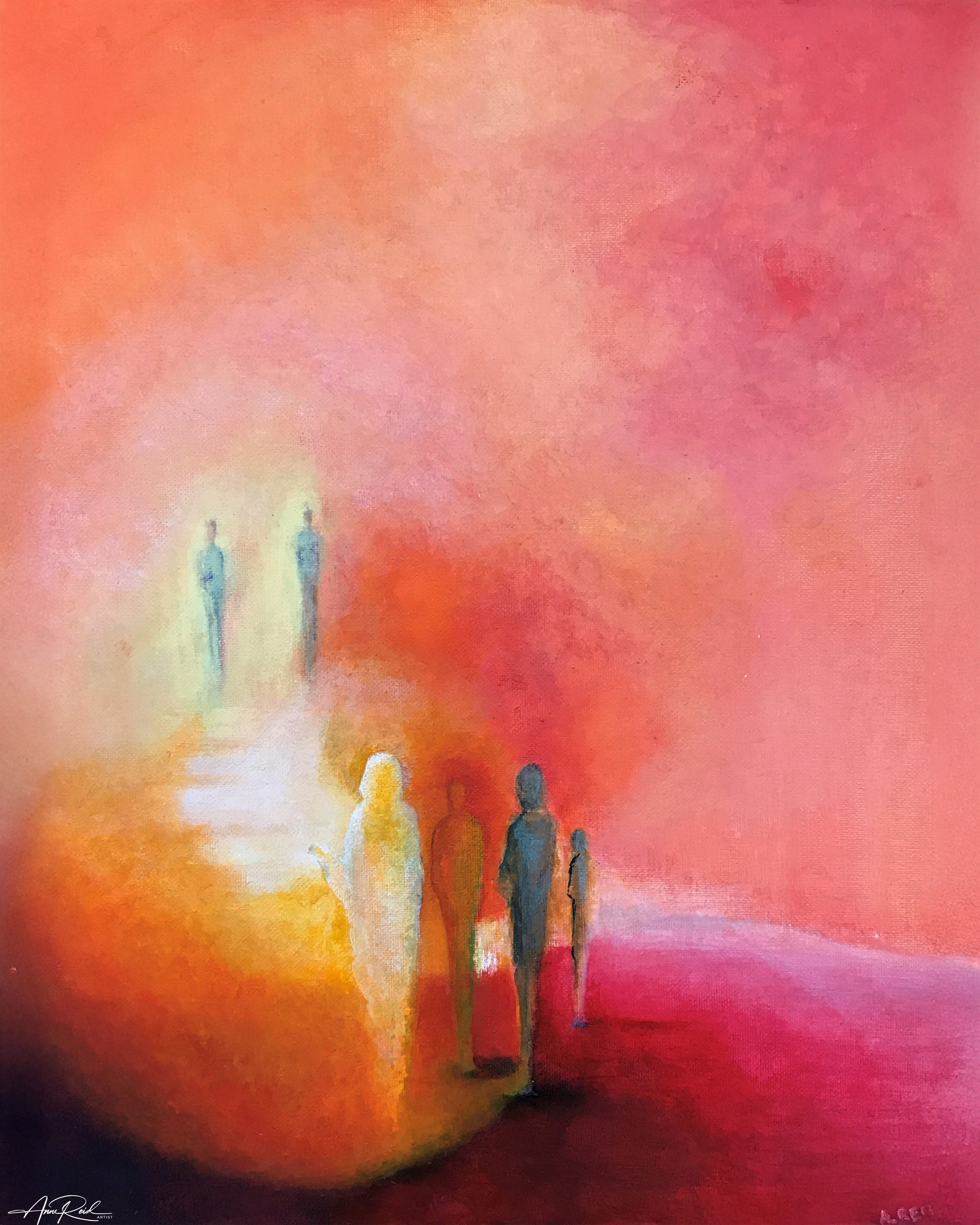
View Transfiguration fine art print →
The Ekklesia Is the Response — and the Armor Is Real
The Apostle Paul names what we are dealing with directly in Ephesians 6:12: "For we wrestle not against flesh and blood, but against principalities, against powers, against the rulers of the darkness of this world, against spiritual wickedness in high places." Paul is not being metaphorical. He is describing a hierarchy — organized demonic authorities exercising influence over nations, cultures, and worldly systems; entities promoting the ignorance of God and moral darkness; supernatural malicious beings operating in the unseen realm. This is the same landscape Heiser maps from the Hebrew Bible. Paul is not introducing a new idea. He is naming, in the language of his own tradition, what the Old Testament has been describing all along.
The New Testament is equally clear about the outcome. Colossians 2:15 states that on the cross, Christ disarmed these powers and triumphed over them publicly. Romans 8:38–39 declares that no principality, no power, no spiritual force can separate believers from the love of God. The hierarchy is real. The defeat is also real. And the Ekklesia — the governing arm of Christ on the earth — is the body through which that victory is enforced and extended in the earth.
The Ekklesia is engaged with these forces through spiritual warfare and through building — and those are not separate activities. The Ekklesia builds what the enemy cannot hold. The Ekklesia prays and the scroll opens further. Heiser connects Pentecost with the Babel reversal and Deuteronomy 32 — the nations disinherited after Babel, given over to heavenly beings, and the Spirit-empowered Ekklesia sent at Pentecost to begin reclaiming them. The armor Paul describes in Ephesians 6 — truth, righteousness, faith, the Word of God — is not defensive equipment for a retreating army. It is the equipment of an advancing one.
Daniel was told to seal up the vision — it concerned the time of the end. John saw a scroll no one was worthy to open until the Lamb who overcame took it. The signs in the heavens, the increase of knowledge, the replication of the days of Noah — these form a coordinated unveiling. What was sealed is being unsealed. What was hidden is becoming visible. The UAP files fit inside that frame whether the people opening them know it or not. The stories have always been in the Bible. What is happening now is that events are catching up to what Scripture always said — and we are coming into a clearer understanding of what has been, what is now, and what is to come.
Barbara's framework is the necessary corrective to fear: the best days of the church are ahead. The restoration of all things is the direction. Not the end of everything — the restoration of everything. Leading up to the return of the King to the City of David. The Ekklesia advancing. The scroll opening. The promise of Genesis 3:15 reaching its conclusion.
The Arc in the Paintings — and the Rosetta Stone
The stories in these paintings have always been in the Bible. I painted them from Scripture and from the Spirit, one work at a time, before I had a framework for the arc they formed. Seed of the Woman in 2017 — before I went to Israel, before the 2020 intercession, before Lance's broadcast named the mountain. I chose orange and pink because they looked like a bouquet. While working on it I saw what looked like drops of fire falling down the canvas and the thought came: I saw Satan fall like lightning from heaven (Luke 10:18). The fall before Genesis 1:2. The promise of Genesis 3:15 spoken into the chaos that fall had made. The meaning was already in the painting. I did not have language for it yet. That painting is the Rosetta Stone of this era — painted before I could read it.
View Seed of the Woman fine art print →
I painted Deluge as a response to the Genesis flood — judgment interrupting the corruption, preserving the line. Barbara Yoder, who is a collector of Deluge, has preached publicly about a vision she received at Catch the Fire Toronto — a tsunami of glory pouring out. When she first encountered the painting, that is what she saw in it. Then I found Malachi 3:10 and Joel 2:28. The painting may be holding both: the flood that pruned the earth and preserved the line, and the outpouring the line was preserved to release.
I curated an exhibition at QEPCC in Oakville. On one wall I hung Golgotha, Deluge, and Seed of the Woman together — by instinct, not by plan.
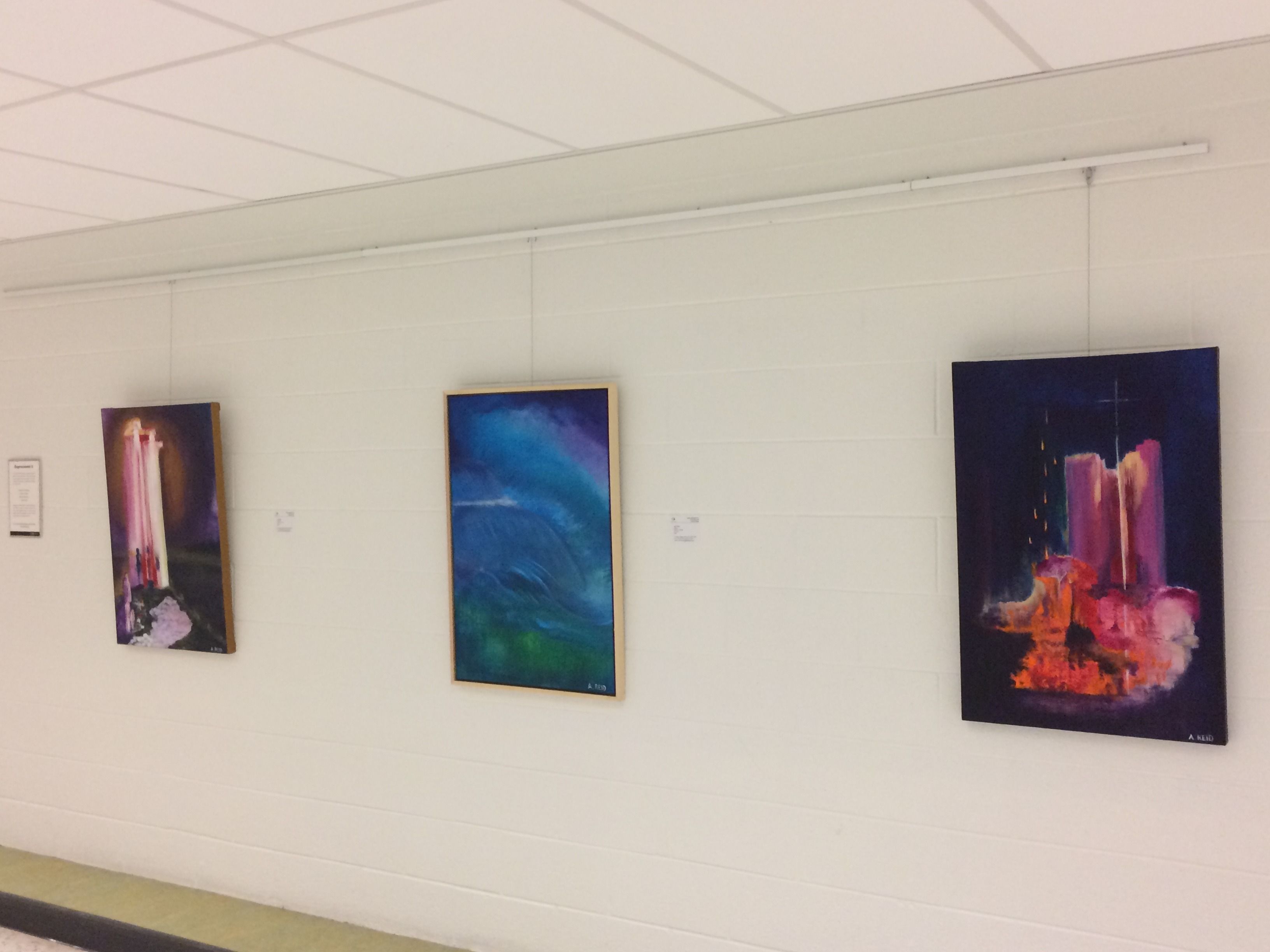
The arc, in order:
Seed of the Woman — Genesis 3:15. The first promise spoken into the conflict. The Seed announced before the battle fully unfolded in history.
Deluge — Genesis 6–9, Malachi 3:10, Joel 2:28. The judgment that preserved the line. And the outpouring the line was preserved to release.
Golgotha — The cost of the promise. The heel bruised. The cross endured. The principalities and powers disarmed in the act that looked like defeat.
Transfiguration — The promised Seed unveiled in glory on the ground the enemy had claimed. The authority of Christ declared over the site of the ancient rebellion.
And a fifth movement the paintings point toward: the Spirit-filled Ekklesia sent out, the floodgates of heaven opened, the restoration of all things underway. The Seed promised. The line preserved. The cost paid. The Son revealed. The Spirit poured out.
My paintings arrive ahead of the understanding and wait for the understanding to catch up. That is what prophetic art does. The stories have always been in the Bible. As events unfold we are coming into a clearer understanding of what has been, what is now, and what is to come. Transfiguration is still giving me things to think about. I suspect it will for a long time.
You can view the paintings in this arc — Seed of the Woman, Deluge, Golgotha, and Transfiguration — as open-edition fine art prints. To talk about any of the works, visit the contact page or reach out directly at info@annereidartist.com.