


What Is Prophetic Art? Meaning, Biblical Roots & Modern Expression | Anne Reid Artist
Jun 09, 2026
About the author: Anne Reid Artist is a contemporary abstract painter whose work explores prophetic art, presence, healing, and the spiritual life of the studio through color, movement, and form. About Anne Reid Artist | Media & Press
Prophetic art is Christian art created in faithful response to God. It bears witness to Jesus Christ by making invisible spiritual realities — presence, truth, healing, hope, and life — visibly tangible through color, movement, and form. It is not defined mainly by style, prediction, or obvious religious imagery. What makes prophetic art prophetic is its source, its obedience, and the life it carries. This page explains what prophetic art means, its biblical roots, how I understand and experience it in my own studio practice, why the living Word matters so deeply in my art making, why names and meaning matter, and how prophetic contemporary fine art can live meaningfully in homes, workplaces, hospitality settings, and sacred spaces.
Overview
Prophetic art is artwork created in faithful response to God that makes invisible spiritual realities — presence, truth, healing, and life — visibly tangible through color, movement, and form. Rooted in the biblical understanding that the testimony of Jesus Christ is the spirit of prophecy, prophetic art is not defined mainly by style or symbolism but by source, obedience, and intent. It carries atmosphere rather than instruction, releasing peace, restoration, and encounter into the everyday spaces where people live and work.
What Do I Mean by Prophetic Art?
Prophetic art is art created in faithful response to God. It is not mainly about predicting the future or using obvious religious symbols. It is about responding in obedience so that the finished work bears witness to Jesus Christ. For me, prophetic art flows out of relationship with God. It is not a formula, and it is not a technique. It is a way of living, listening, responding, and making in His presence.
In biblical terms, prophecy is not primarily prediction. It is revelation that strengthens, encourages, and comforts. Prophetic art functions in the same way, but visually. It carries meaning, atmosphere, and invitation. Sometimes the message is immediately clear. Sometimes it unfolds slowly. Either way, the source is the same.
How did I first encounter prophetic art?
I first encountered what I would later understand as prophetic art in a worship setting. A blank canvas. Music rising. Prayer in the room. As the artist painted, something began to form — color before clarity, movement before meaning. By the end, something unmistakable had settled. God had spoken, not through words, but through paint.
That experience did not resolve my understanding of creativity. It began a long unfolding. Over years of prayer, painting, waiting, and returning to the canvas again and again, my understanding deepened. What I was witnessing was not a moment, but a way of life.
I came to see that art could be more than expression or decoration. It could be communication with God and communication from God. It could be a lifelong pursuit of listening, obedience, and refinement — an invitation to know Him more deeply and to make Him known through what is created.
Does every prophetic artist work the same way?
No. Artists may describe prophetic art differently, and the process does not look the same for everyone. Some may receive a clear image before they begin. Others may work more spontaneously. What I am describing here is my own understanding and experience of prophetic art as Anne Reid Artist.
What is prophetic art not?
- It is not defined mainly by a style label.
- It is not simply decorative Christian art.
- It is not only about prediction or coded symbolism.
- It is not creative control dressed up as spirituality.
What makes prophetic art prophetic?
- Its source in prayer, dependence, and partnership with the Holy Spirit
- Its obedience rather than self-directed control
- Its witness to Jesus Christ
- Its ability to carry atmosphere, invitation, and life
The Biblical Roots of Prophetic Art
At its core, prophecy is the testimony of Jesus Christ — His character, His nature, His love, and His redemptive purpose. Prophetic art bears witness to who He is, often without overt religious imagery, just as creation itself reveals God without words.
Genesis reveals a God who creates by speaking — bringing light into darkness, form out of what is formless, and life out of what seems empty. The Gospel of John reveals that this creating Word is Jesus Christ Himself: the Word who was with God in the beginning, the Word through whom all things were made, and without whom nothing was made that has been made.
If the testimony of Jesus Christ is the spirit of prophecy, and Jesus Christ is the Word, then prophetic art cannot be rightly understood apart from Him. True prophecy is the unfolding revelation of Jesus Christ — His nature, His character, His heart, and His redemptive purpose.
Biblical ideas that shape prophetic art
- Prophecy strengthens, encourages, and comforts.
- The testimony of Jesus is the spirit of prophecy.
- All things were made through the Word.
- Creation reveals God through beauty, order, and life.
- The Holy Spirit leads believers into truth and revelation.
Why does the Word matter so much in my art making?
I do not usually set out to paint a picture about a specific Bible passage that inspired me. The Word of God already lives in me — through a lifetime of being formed by it, and because Christ Himself, the living Word, dwells in the believer by the Holy Spirit.
Believers are the temple of the Holy Spirit, a place of habitation where He lives. So when I paint, I am not reaching outside myself for detached inspiration. The source is already living within. The Word speaks from that place.
If the source of the work is the Word, then of course the work may carry a word. Sometimes the painting sends me back into the Word. Sometimes the Word opens around the painting and reveals what it is carrying. The Word is often the Rosetta Stone to the artwork — the key that unlocks its meaning.
What does Bezalel show us about prophetic art?
Bezalel matters to me because he shows that Spirit-filled craftsmanship is biblical. He was filled with the Spirit not merely to speak, but to make — to build the tent of meeting and the sacred articles connected to it.
That work was not decorative. It helped reveal the God of Israel to a people coming out of Egypt, a culture shaped by false worship and distorted spiritual vision. Through holy craftsmanship, beauty, skill, order, and material form became part of revelation. Spirit-filled making is not a modern invention. Scripture shows that craftsmanship, holiness, and revelation can belong together.
What does it mean that the Word is made flesh?
John does not only tell us that Jesus is the Word through whom all things were made. He also tells us that the Word became flesh and dwelt among us. That means the life of God is not meant to remain abstract. What is true in God can take visible, embodied, material form in the world.
Prophetic art does not repeat the incarnation, and it does not replace the written Word. But it can become a material witness to the One the Word reveals. In that sense, what begins in God can take form in color, movement, atmosphere, and matter. Across Scripture there is a progressive revelation of God that culminates in Jesus Christ and ends in the unveiling of Jesus Christ in Revelation. At its best, prophetic art does not compete with revelation. It bears witness to it.
How I Work as a Prophetic Artist
For me, prophetic art does not begin with a formula. It flows out of relationship with God. Sometimes I am simply with Him as I paint. Sometimes I have to stop and ask Him specifically about the work. Sometimes I ask, "What is this?" Sometimes I just see. It is relationship, not a prompt.
I often begin abstractly, then look to see what is emerging, and use the skills I have developed to bring it out. The process is not about forcing meaning onto the canvas. It is about attention, discernment, response, and skilled making in the presence of God.
The Holy Spirit is not merely an influence on my work. He is the source, the conduit, and the overflow. Whatever state I am in, I can do nothing without Him. As I abide in Christ, the work becomes a place of dependence, fruitfulness, and response.
How the process usually unfolds
- Relationship with God remains the ground of the work.
- Sometimes I paint in quiet communion; sometimes I stop and ask specific questions.
- I often begin abstractly, then discern what is emerging.
- I use practiced skill to bring the work into clarity and form.
- Meaning may deepen during the making or unfold over time.
Why are names so important in my work?
The names of my paintings matter deeply to me. Sometimes I receive the name first. Sometimes the image comes first. Sometimes the title and the meaning become clearer together over time. The title is not decoration. It is often part of the discernment.
If a name comes first, I may associate that name with certain passages or study further to understand what the work is carrying. The image, the name, and the Word often come together in a living relationship. This matters to me because names matter in Scripture. In Genesis, the one made in the image of God is given the task of naming creation. Naming has to do with identity, recognition, and meaning. In the same way, the name of a painting can become a key that helps unlock what God is saying through it.
Holiness, Healing, and Restoration
What is holy about prophetic art?
There is something holy about prophetic art in the sense that it belongs to God in source and purpose. The believer is the temple of the Holy Spirit. God dwells with man in the redeemed person. So prophetic art emerges from a life that is already a place of habitation.
That does not make the artwork scripture, nor does it make the object itself magical. But it does mean the work can emerge from consecration, devotion, and indwelling presence. In that sense, prophetic art comes out of the temple of the Holy Spirit. This is also why I understand the prophetic artist as carrying both priestly and prophetic dimensions: priestly in devotion, consecration, and attending to God; prophetic in revelation, witness, and release.
How does prophetic art relate to healing and the restoration of all things?
For me, prophetic art is not only about individual inspiration or private meaning. It belongs inside the larger restoration story of Scripture. Christ is retained in the heavens until the restoration of all things, and the biblical story moves toward God dwelling with man — not only in shadow, but in redeemed reality.
From the tabernacle to the tabernacle of David to the New Jerusalem, Scripture carries a movement toward habitation, unveiling, and glory. God's purpose has always moved toward dwelling with man, filling His house with His presence, and restoring His image in redeemed humanity.
In that sense, prophetic art can participate in the restoration of all things — not by replacing the gospel, and not by standing above the written Word, but by bearing witness to the presence, character, and nearness of God in material form. It can help re-order perception, awaken remembrance, and make room for peace, truth, beauty, and healing in places shaped by strain, confusion, or false vision.
Why is healing central to prophetic art?
Healing is central to prophetic art because the presence of Jesus heals us. It restores what has been worn down. It brings peace where there has been strain.
When art carries glory — His revealed goodness — it can minister quietly and continuously. People may not have language for what they are experiencing, but they feel steadied, comforted, or reminded of hope. This is not emotional manipulation. It is the fruit of presence.
What healing can look like in a room
- A sense of peace where there has been tension
- Quiet reassurance in seasons of strain
- A reminder of hope, steadiness, and nearness
- An atmosphere that supports rest, prayer, or restoration
How the Prophetic Message Continues Through Story, Speech, and Writing
The painting is not the end of the matter. As I press into its meaning, the story of the artwork may also emerge. Then the opportunity to share that story becomes part of the prophetic message itself.
The prophetic gift usually works through spoken word or written word — through language and communication. So when I speak or write about a painting, I am not simply adding commentary after the fact. I am helping release the word the work is carrying.
The word is creative. We make declarations because words create. So when I create with God in art making and then release that word into the world, something is happening twice over: first, an artwork is created; then, through faithful testimony, something of its living reality is released into the world through speech and writing.
Why Encounter, Presence, and the Testimony of Jesus Matter So Much
Prophetic art is about encounter. It is about making invisible realities visible — truth, light, beauty, redemption, hope, purpose, love, and healing. Above all, it is about presence.
Jesus is the way, the truth, and the life. His presence heals, restores, and brings peace. When He reveals Himself to us, we begin to understand who we are. Prophetic art that carries His testimony should do the same — release life, not performance. This is why works such as Fourth Man matter to me. That painting speaks to the sustaining presence of Christ — the One who stands with us in the fire, who fills us, keeps us, and releases His life to us and through us. It is also why the Angels & Presence Collection exists. These paintings are not illustrations of wings, but expressions of movement, protection, and nearness — a reminder that heaven is not distant.
Where Does Prophetic Art Belong?
Prophetic art is not meant to remain in galleries or sacred spaces alone. It belongs in homes, workplaces, hotels, clinics, offices, and public spaces — where real life is happening every day.
Jesus did not wait for people to come to Him. He went where they were — homes, roads, markets, wells. His presence brought life into ordinary places, not only through sermons, but through nearness. In the same way, prophetic art carries presence into the spaces people actually inhabit. It does not demand attention or explain itself. It quietly releases peace in a hallway, reassurance in a bedroom, steadiness in a workplace, and rest in a waiting room. This does not require religious iconography. Creation itself testifies to God through beauty, order, and life. Prophetic art works the same way.
Spaces where prophetic art can live well
- Homes and bedrooms
- Hallways and quiet transitional spaces
- Clinics, offices, and waiting rooms
- Hotels and hospitality spaces
- Prayer rooms and sacred environments
Why Is This a Lifelong Calling for Me?
Prophetic art is not about talent. It is about willingness. For me, it has become a vocation worth giving my life to — spiritually, creatively, and practically. It continues to draw me back into listening, humility, and faithfulness. My prayer for every piece I create is simple: that it would carry truth, release life, and quietly make Jesus known — long after the brush is set down.
Prophetic Fine Art in Practice
This understanding of prophetic art is not theoretical. It shapes how I paint, how I name collections, and how individual works are placed into real rooms and real lives.
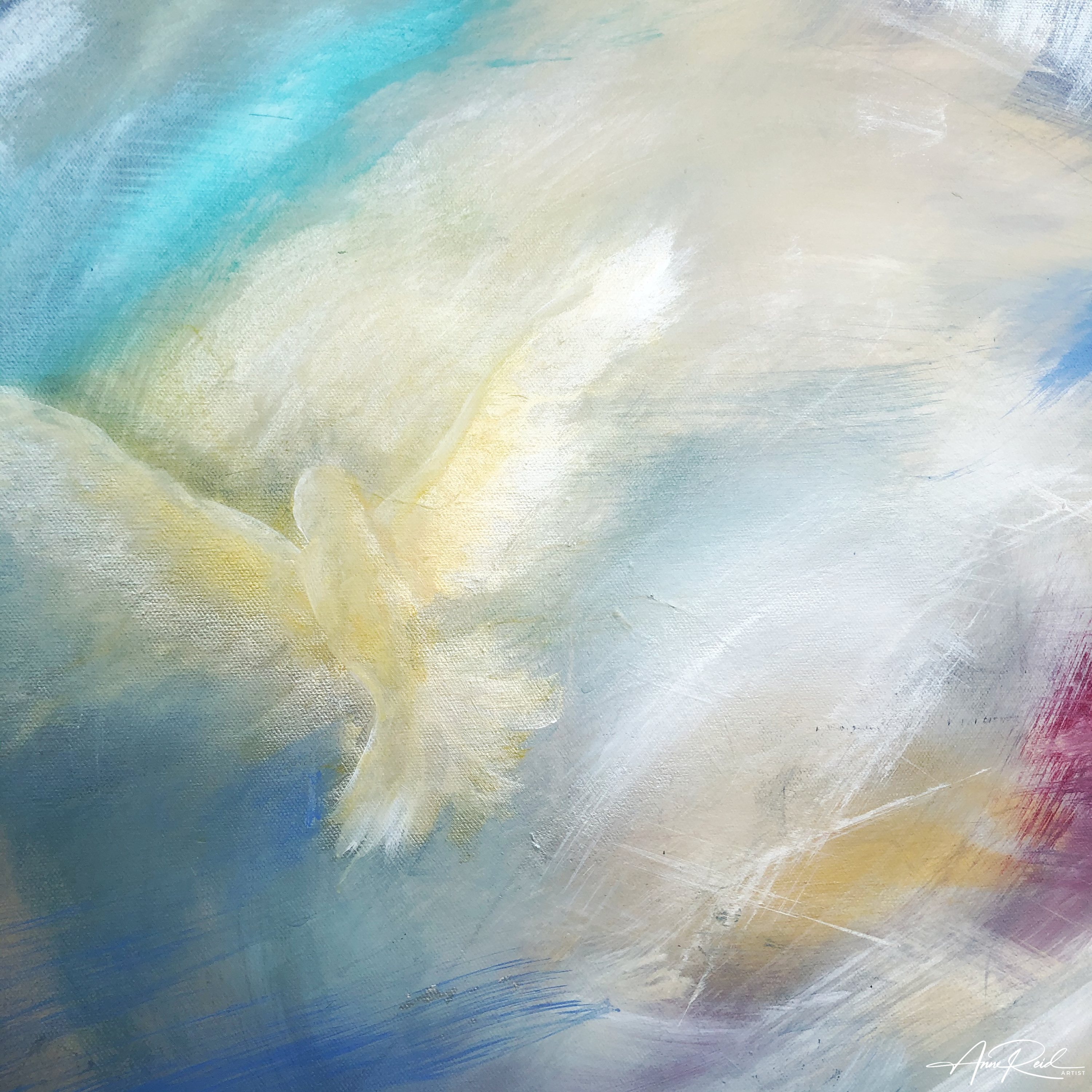
If you want to see how prophetic art supports the home, start with Creating a Sacred Space at Home with Spiritual Art, then continue into works such as Fourth Man, Dove, and Deluge.
If you want to explore prophetic art through watchfulness, nearness, and spiritual atmosphere, browse the Angels & Presence Collection. If you want to see how this work translates into refined listening-room and design-aware settings, read Why My Metal Prints Belong in Listening Rooms and then explore the Metal Wall Art: The Audiophile Collection.
If you want to move from topic understanding into broader collecting, continue into the She Leads Collection or browse the full range of Large-Scale Fine Art Prints. If you have questions about a specific piece or want guidance on placement in your space, reach out through the contact page.
Prophetic art is not decoration. It is presence made visible — expressed through contemporary fine art and meant to shape the atmosphere of the spaces we inhabit.
Frequently Asked Questions
Is prophetic art just another style of Christian art?
No. Prophetic art is not defined mainly by style. It is defined by source, partnership with the Holy Spirit, and a desire to bear witness to Jesus Christ.
Does prophetic art have to include obvious religious imagery?
No. Prophetic art can be abstract, symbolic, or minimal. Like creation itself, it can reveal God without relying on literal religious iconography.
Is prophetic art mainly about prediction?
No. In biblical terms, prophecy is not primarily prediction. It is revelation that strengthens, encourages, comforts, and bears witness to Jesus Christ.
Can prophetic art belong outside churches or prayer rooms?
Yes. Prophetic art belongs in homes, offices, hospitality spaces, clinics, and other everyday environments where people live, work, heal, and rest.
What should prophetic art release into a space?
At its best, prophetic art releases peace, reassurance, healing, truth, and the sense of God's nearness rather than merely decorating a wall.
Does every prophetic artist experience the process the same way?
No. Artists may describe prophetic art differently. Some may receive a clear image before they begin, while others may discover the work as it unfolds. What I describe here is my own lived experience of painting in relationship with God.
Why does the Word matter so much in your work?
Because the testimony of Jesus Christ is the spirit of prophecy, and Jesus Christ is the Word. The Word is often the Rosetta Stone to the artwork — the key that helps unlock its meaning and reveals what the painting is carrying.
Why does Bezalel matter here?
Because Bezalel shows that Spirit-filled craftsmanship is biblical. Scripture includes a pattern in which God fills a maker with His Spirit so that beauty, skill, holiness, and revelation can come together in material form.
How does prophetic art relate to restoration?
Prophetic art belongs inside the larger restoration story of Scripture. It does not replace the gospel, but it can bear witness to God's presence, character, and nearness in material form, making room for peace, beauty, healing, and restored perception in the world we inhabit.